Dysarthria Exercises: Rate, Phrasing and Clear Speech
Dysarthria therapy can work on rate and pacing, phrasing and breath, loudness and clear articulation. The right strategies depend on the cause and type of dysarthria, and slowing down or speaking louder doesn’t help everyone. If speech changes suddenly, call emergency services.
What dysarthria therapy works on
If speech changes suddenly
Speech that suddenly becomes slurred or garbled, especially with a face drooping on one side or being unable to lift both arms, can be a sign of a stroke, which is a medical emergency. Call your local emergency number straight away (999 in the UK, 911 in the US). Stroke symptoms that stop after a short time still need medical help straight away. If new difficulty talking has come on gradually, see a doctor.
Dysarthria is a speech disorder caused by brain or nerve damage that changes how the muscles for speech work, so speech can sound slow, slurred or hard to understand. ASHA’s clinical description covers the strength, speed, range, steadiness and accuracy of the movements used for breathing, voice, resonance, articulation and prosody.3,2
What you work on with a speech-language pathologist (SLP) depends on the type of dysarthria and how much of a problem it is for you. ASHA’s public guidance lists slowing down your speech, talking louder, moving your lips and tongue more, and saying sounds clearly in words and sentences. Its clinical guidance adds that not every technique suits every person or every situation.3,2
The research base is still small. A Cochrane review of dysarthria after stroke and other non-progressive brain injury found five small trials with 234 participants and no definitive trials, and said people should keep receiving rehabilitation according to clinical guidelines. The UK and Ireland stroke guideline likewise notes little evidence for the interventions in common use, with some evidence of qualitative benefits.13,8
Rate and pacing
For a reduced speaking rate, ASHA lists pacing strategies such as hand tapping, a pacing board or a metronome, along with delayed auditory feedback and indirect strategies like increased loudness or overarticulation. A slower rate is thought to help intelligibility for speakers with dysarthria because it gives more time to reach mouth shapes that are distinct from one another.2,12
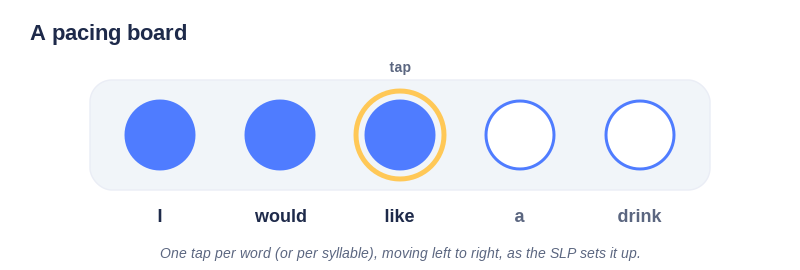
Parkinson’s UK describes pacing boards as physical or digital aids sometimes used in speech pacing therapy, so you can count out your words more slowly.9
In the illustration, the speaker touches one section at a time. Whether a pacing board suits you, and how to use it, is for your SLP to decide; this page describes pacing boards rather than teaching them.
The evidence on rate control is mixed. ASHA’s summary of a 2007 systematic review called the evidence for rate control in adults with dysarthria preliminary. In a study of 50 speakers, 43 of them with dysarthria, cues to slow down or speak louder did not help every speaker, and in a study of seven speakers with dysarthria due to multiple sclerosis, slowing down improved intelligibility for four and reduced it for three. Slower speech in dysarthria also tends to be perceived as less natural, regardless of whether the slower rate improves intelligibility.4,14,15,12
If your SLP has asked you to work on rate, the free speaking rate test gives you a record to compare with your own earlier results. You read a short passage aloud, then talk freely for 30 seconds, and see each part’s rate in syllables per second side by side. It’s analysed on your device, the result is indicative, not a diagnosis, and it doesn’t identify dysarthria or any other condition.
Free Speaking Rate Test
Read a short passage aloud, then talk freely for 30 seconds. Analysed on your device; indicative, not a diagnosis.
Phrasing and breath
ASHA describes phrase grouping as choosing a phrase length that fits your breath support and the grammar of the sentence: for each breath, saying only the number of syllables you can produce comfortably. It also lists matching breaths to natural pauses in speech.2
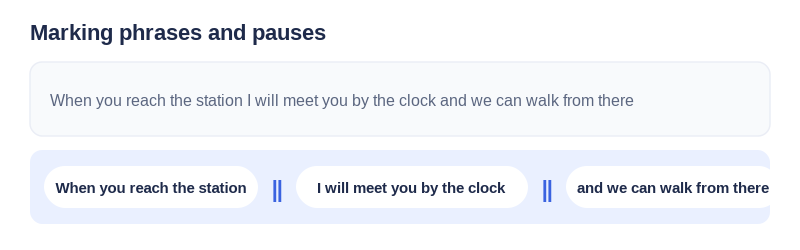
ASHA’s public page suggests pausing often, which lets the other person think about what you’ve said, and the MS Trust suggests speaking slowly and regularly and keeping sentences short.3,11
SpeechStep’s phrase pacing exercise uses this idea in a practice format: ‖ marks where to pause, as in the illustration above. The aim is controlled speech, not slower speech. Where the breaks fall and how long each phrase should be are things to agree with your SLP.
Loudness and clear speech
ASHA describes exaggerated articulation, or overarticulation, as a way to emphasise sound placement and increase precision, sometimes called “clear speech”. In a study where 78 speakers, including people with mild dysarthria from multiple sclerosis or Parkinson’s, read sentences mixed with background babble, loud and clear speech improved intelligibility compared with habitual speech, but slow speech did not.16,12
For Parkinson’s and hypokinetic dysarthria, ASHA’s summary of the 2007 review found the strongest evidence for treatments that change vocal loudness. One example is LSVT LOUD, which ASHA describes as an intensive programme targeting high vocal effort to improve loudness; the Parkinson’s Foundation says an SLP certified in LSVT delivers it.4,2,10
In the 50-speaker study, cues to speak louder and reduce rate did not help every speaker, and speakers with a breathier voice tended to do better in the loud condition than in the slow one.14
So the choice depends on the person, and programmes like LSVT LOUD are learned with a trained clinician. SpeechStep doesn’t measure loudness or voice quality, so this part of therapy stays with your SLP.
Changing the setting: listeners and noise
Dysarthria therapy isn’t only about the speaker. NICE’s stroke rehabilitation guideline says environmental barriers to communication should be kept to a minimum, for example by limiting background noise, and the UK and Ireland stroke guideline says communication partners of a person with severe dysarthria should be trained in how to help.7,8
- Talk in a quiet, well-lit room so everyone can hear and see clearly.
- If you catch only part of a message, repeat back the part you understood.
- Give time and attention, try not to interrupt, and allow silences.
- Choose a moment when the speaker has energy to talk.
- Keep important conversations one to one where you can.
These tips come from ASHA’s public dysarthria page and the Stroke Association. ASHA notes that talking can be tiring and speech may be harder to understand when you’re tired; the Stroke Association adds that fatigue after a stroke can be worse in the afternoon and that a one-to-one conversation is easier than a group chat.3,6
Practising within an SLP’s plan
After a stroke, NICE recommends referring anyone with suspected communication difficulties to a speech and language therapist for detailed assessment. The Stroke Association says progress in therapy only comes with practice, and that apps and computer programmes for practising work best with some guidance from a speech and language therapist.7,5
If your SLP is happy for you to practise pacing at home, SpeechStep Pacing, on the web for teens and adults, offers steady reading with the passage highlighted at a steady guide pace, phrase pacing and pause practice. A free account includes two pacing sessions, then Premium. Feedback is neutral, and a re-test uses a matched passage with the same method, so you can compare with your own earlier results. Any rate or phrasing target comes from your SLP, not from SpeechStep.
What SpeechStep can and can’t do
SpeechStep is practice, not therapy. It doesn’t diagnose, assess or treat dysarthria, doesn’t measure loudness or voice quality, and doesn’t offer delayed auditory feedback or any named therapy programme. The speaking rate test is indicative, analysed on your device and not a diagnosis. If you opt in, an authorised SpeechStep reviewer may listen to eligible recordings, but that isn’t clinical guidance. The aim is controlled speech, not slower speech.
When to see an SLP
See an SLP if your speech has become harder for others to understand, people often ask you to repeat yourself, or talking has become tiring or is affecting your work and social life. If speech changed suddenly, call your local emergency number first. Our find support page explains how to find an SLP through your country’s register, and a doctor can also advise on referral.
Frequently asked questions
What exercises help dysarthria?+
ASHA lists slowing down your speech, talking louder, moving your lips and tongue more, and saying sounds clearly in words and sentences. Which of these suits you depends on the type of dysarthria and how it affects you, so an SLP chooses the strategies and sets them up with you.
Can I do dysarthria exercises at home?+
Home practice is part of therapy: the Stroke Association says progress only comes with practice. It also says apps and computer programmes work best with some guidance from a speech and language therapist, so practise the strategies your SLP has given you.
Do speech exercises help slurred speech after a stroke?+
The UK and Ireland stroke guideline says people whose dysarthria limits communication should be trained in techniques to make speech clearer. A Cochrane review found only five small trials and no definitive ones, so the evidence is still limited. If slurred speech comes on suddenly, call your local emergency number straight away.
Does speaking slowly help dysarthria?+
For some people. In a study of seven speakers with dysarthria due to multiple sclerosis, slowing down helped four and made three harder to understand, and in another study loud and clear speech helped intelligibility while slow speech did not. An SLP can work out whether rate is worth working on for you.
Do tongue and lip exercises help dysarthria?+
A Cochrane review found a short-term improvement in muscle movement such as tongue and lip control, but said the result isn’t reliable because it came from small numbers of people. Ask your SLP whether these exercises are part of your plan.
Can SpeechStep tell me if I have dysarthria?+
No. SpeechStep doesn’t diagnose, assess or treat dysarthria, and the speaking rate test is indicative, analysed on your device and not a diagnosis. If you notice new difficulty talking, see a doctor, and call emergency services if it’s sudden.
Practise your own speech, one sound at a time
Free with an account: your first practice day is a full session of 14 words, then 5 words a day, with AI feedback on the sounds it supports. SpeechStep is practice, not therapy, and it doesn’t diagnose.
Need a licensed professional? Where to find a speech-language pathologist
References
16 sources from authoritative bodies. Last reviewed November 2026.
- 1.NHS (nhs.uk)Dysarthria (difficulty speaking) — Health A to Z page, 2023.
- 2.ASHADysarthria in Adults (Practice Portal) — Practice Portal page.
- 3.ASHADysarthria (public information page; last reviewed 1 May 2026) — Patient information page, 2026.
- 4.ASHAEvidence for Effectiveness of Treatment of Loudness, Rate, or Prosody in Dysarthria: A Systematic Review — Evidence Map summary of a systematic review, 2007.
- 5.Stroke Association (UK charity)Communication treatment and tools — Patient information page, 2025.
- 6.Stroke Association (UK charity)Tips for aiding communication — Patient information page, 2025.
- 7.National Institute for Health and Care Excellence (NICE)Stroke rehabilitation in adults (NG236): Recommendations — Guideline, 2023.
- 8.Intercollegiate Stroke Working Party, National Clinical Guideline for Stroke for the UK and Ireland (copy hosted by Western Health and Social Care Trust, Northern Ireland)National Clinical Guideline for Stroke for the UK and Ireland, 2023 edition (sections 4.43 Aphasia, 4.44 Dysarthria) — Guideline, 2023.
- 9.Parkinson's UKSpeech and communication problems (last updated 13 December 2024) — Patient information page, 2024.
- 10.Parkinson's Foundation (US)Speech & Swallowing Issues — Patient information page.
- 11.MS Trust (UK charity)Speech problems (last updated 1 January 2022) — Patient information page, 2022.
- 12.Journal of Speech, Language, and Hearing Research (author manuscript via PMC)Impact of Clear, Loud, and Slow Speech on Scaled Intelligibility and Speech Severity in Parkinson's Disease and Multiple Sclerosis (Tjaden, Sussman, Wilding) — Journal article, 2014.
- 13.Cochrane Database of Systematic Reviews (abstract and plain language summary via PMC)Interventions for dysarthria due to stroke and other adult-acquired, non-progressive brain injury (Mitchell, Bowen, Tyson, Butterfint, Conroy) — Systematic review, 2017.
- 14.Journal of Speech, Language, and Hearing Research (abstract via PMC)Predicting Intelligibility Gains in Individuals With Dysarthria From Baseline Speech Features (Fletcher, McAuliffe, Lansford, Sinex, Liss) — Journal article (abstract), 2017.
- 15.American Journal of Speech-Language Pathology (abstract via PMC)Investigating Acoustic Correlates of Intelligibility Gains and Losses During Slowed Speech: A Hybridization Approach (van Brenk, Kain, Tjaden) — Journal article (abstract), 2021.
- 16.ASHADysarthria in Adults (Practice Portal) — Professional practice guidance page.
Keep reading
Dysarthria in Adults
What dysarthria is, its types and common causes.
Read →Pacing Boards in Speech Therapy
What a pacing board is and how SLPs use it.
Read →Speech Rate Control
What research says about slowing speech in dysarthria.
Read →Speech After a Stroke
Communication changes after stroke and how recovery is supported.
Read →