How to Enunciate: Stop Mumbling and Rushing Your Words
To enunciate, make your consonants crisp, finish every word and pause where a thought ends. Clear speakers typically speak more slowly and more loudly too, but in one study slowing down alone didn’t help listeners. The aim is controlled speech, not slower speech.
What clear speakers do differently
Researchers call it clear speech: a speaking style in which talkers voluntarily adjust their usual speech to be as intelligible as possible for the person they’re talking to. Talkers may use it in a noisy place or when talking to someone with a hearing impairment.10
A review of clear-speech research found that talkers trying to be more intelligible typically speak more slowly, more loudly and with more exaggerated articulation, and that naturally produced clear speech typically includes longer and more frequent pauses. In one set of recordings, clear speech was generally slower, louder and more clearly articulated than conversational speech, and sentence intelligibility was substantially higher.1,12
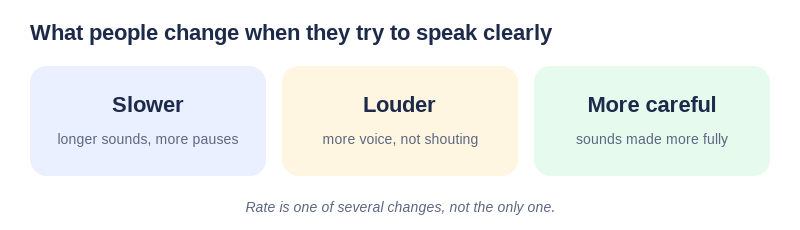
Clear speech involves a slower rate and more voice, but researchers describe its focus as exaggerated articulation, or hyperarticulation. With training, talkers can produce clear speech at conversational rates, and it still increased intelligibility for normal-hearing listeners with simulated hearing losses, in noise, though slightly less than clear speech at slow rates. In a study of 78 speakers reading sentences mixed with background babble, loud and clear speech improved intelligibility compared with habitual speech but slow speech didn’t, and for the control speakers, slow speech was less intelligible than their habitual speech.9,1
Clear speech is generally accompanied by at least some increase in vocal intensity. That doesn’t mean shouting: ASHA’s advice for talking with someone who has hearing loss is to speak clearly in your regular tone of voice, because shouting just makes it harder for the person to understand you.10,5
Why speech turns into mumbling
MIT’s communication lab notes that pace affects enunciation: a tricky phrase is easier to say when you’re speaking slowly than when you’re rushing. It adds that mumbling and rushed speech leave an audience struggling to keep up, and a University of Tennessee speaking guide notes that talking at speed can make you stumble over your words or leave your audience missing what you say.18,17
Listeners are working while you talk: they hear and process what you say at the same time. Researchers note that artificially sped-up speech can deprive listeners of the processing time they ordinarily have, and in a study of younger and older normal-hearing adults, older listeners were at a much greater disadvantage with naturally fast speech than results for sped-up recordings predicted.18,7,6
The US National Institute on Aging lists having a problem understanding speech because of background noise, and thinking that others seem to mumble, among the signs of hearing loss.4
So if one person often says you mumble, it’s worth thinking about the room and their hearing as well as your own speech.
Mumbling isn’t the same as having an accent. ASHA notes that a person can have a noticeable accent and still be clearly intelligible. In one study, proficient non-native talkers who switched to clear speech in their second language became significantly easier to understand, while their accent stayed the same.14,8
Open the mouth, finish the word, use the pause
Stanford’s Oral Communication Program puts it simply: clarity is more important than volume, and clarity is all about articulating consonants. Speaking guides ask whether every sound of every word makes it out of your mouth, and say words should be pronounced clearly and completely. In a study where 12 speakers produced sentences that were mixed with background babble and transcribed by 40 listeners, the instruction to “overenunciate” gave the greatest intelligibility benefit over habitual speech, followed by “talk to someone with a hearing impairment” and then “speak clearly”.16,17,18,11
In practice, try making the consonants at the start and end of words crisp, letting your mouth open a little more on vowels and sounding the last part of every word. It can help to exaggerate on purpose while you practise, then ease back to something that still sounds like you.
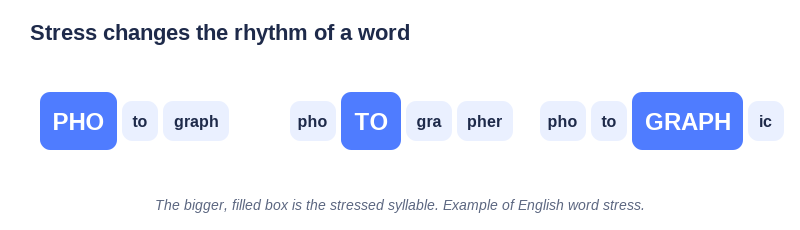
ASHA describes stress as the prominence or emphasis on a particular part of an utterance or a syllable, and English is perceived as having a high contrast in length between stressed and unstressed syllables. Researchers studying speech rhythm in dysarthria have suggested that English listeners rely on this contrast to find word boundaries, so reducing it lowers intelligibility.14,13
A University of Tennessee speaking guide calls pauses vocal punctuation, working like commas and full stops, and suggests pausing after complete thoughts to give your audience a little time to think about what you’ve said. In one study with 27 normal-hearing young adults, inserting silent pauses at meaningful points in a sped-up story brought recall back close to the level at the original, unaltered rate, and the researchers note that pauses inserted at random points, unrelated to the structure of clauses, give little or no improvement in recall.17,7
Practise with reading aloud
Reading aloud is a good place to put this together, because the words are fixed and you can come back to the same paragraph each day. Keep sessions short and regular, and change one thing at a time.
- 1Choose a short paragraph of something you’d actually say, such as an email, a news story or a few lines of a talk.
- 2Mark ‖ wherever a phrase ends, usually at commas, full stops and natural breaks in meaning.
- 3Read it once at your usual pace, finishing every word and pausing briefly at each mark.
- 4Read it again, overenunciating on purpose: crisp consonants, open vowels, every word ending.
- 5Read it a third time somewhere between the two, keeping what still sounds like you.
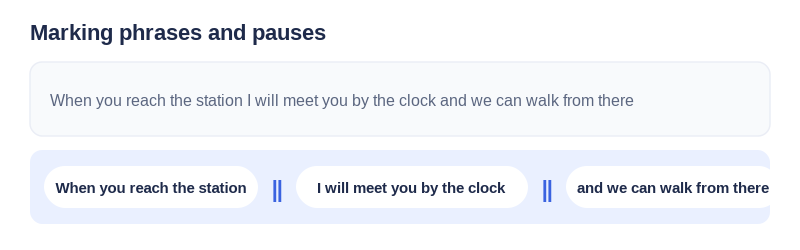
In SpeechStep Pacing, the phrase pacing exercise marks the pauses for you with ‖, as in the illustration above, steady reading highlights a passage at a steady guide pace, and pause practice works on the pauses themselves. Feedback is neutral, and results are kept by task so you can see your own change. The aim is controlled speech, not slower speech: words finished, phrases grouped and pauses where the meaning breaks. A free account includes the first two pacing sessions; after that it’s part of Premium.
Record, listen back, compare
MIT’s communication lab notes that it’s hard to self-assess the rate you’re speaking at, and suggests practising with someone or recording yourself. In a study of ten talkers who each performed a set of three speech tasks four times in two speaking styles, speaking rate and other measures could change significantly from one repetition to the next, even with a brief practice set and especially in the conversational style.18,19
So compare like with like: use the same paragraph, the same room and the same distance from the microphone each time, and look at the trend across several recordings rather than a single take. When you listen back, listen for these:
- Word endings that vanish, such as the last t, d or s.
- Words that run into each other so a phrase sounds like one long word.
- Phrases that rush to the end without a pause.
- A voice that fades away at the end of sentences.
- Long words where the stress has flattened out.
Free Speaking Rate Test
Read a short passage aloud, then talk freely for 30 seconds. Analysed on your device; indicative, not a diagnosis.
SpeechStep’s free speaking rate test gives you a starting point for pace. You read a short passage aloud for about 30 seconds, then talk freely for 30 seconds on a prompt, and it shows each part’s rate in syllables per second side by side, with pauses and long pauses under “View details”. The recording is analysed on your device and isn’t saved unless you create an account. Results are indicative, not a diagnosis, and the free-speech number is approximate; background noise can add or hide syllables, so record somewhere quiet and compare with your own earlier results.
When unclear speech needs an SLP
If someone has difficulty speaking and their speech is slurred or garbled, especially if their face droops on one side or they can’t lift both arms and keep them there, these can be signs of a stroke, which is a medical emergency: call your local emergency number at once (999 in the UK, 911 in the US). ASHA’s public advice is to see a doctor right away about any new difficulty talking, and to call 911 for any sudden changes in speech or communication.2,15
ASHA describes dysarthria as a speech disorder that happens when brain or nerve damage changes the way your muscles work, and lists signs including slurring or mumbling when you talk, talking “too slowly or too fast”, talking too quietly or too loudly, and difficulty moving your tongue, lips and jaw. For gradual changes to your speech that worry you, the NHS advises seeing a GP. ASHA says work with an SLP depends on the type of dysarthria and how much of a problem it is for the person, and may include slowing down, talking louder, moving the lips and tongue more and saying sounds clearly in words and sentences.15,2,3
If any of these signs are new for you, don’t try to work it out alone: sudden changes need emergency help first, and gradual ones are worth raising with a doctor or a speech-language pathologist (SLP). SpeechStep’s find-support page explains how to find an SLP through your country’s register.
What SpeechStep can and can’t do
SpeechStep helps you practise pacing. The speaking rate test shows your rate and pauses, and SpeechStep Pacing offers steady reading, phrase pacing and pause practice with neutral feedback. It doesn’t measure loudness or voice quality, and it doesn’t identify, diagnose or treat any speech condition. It’s practice, not therapy.
Frequently asked questions
How do I enunciate words clearly?+
Make your consonants crisp and say every word clearly and completely, including its last sound. In one study of 12 speakers heard in background babble, the instruction to “overenunciate” gave a bigger intelligibility benefit than “speak clearly”. To practise, exaggerate on a read paragraph, then ease back until it still sounds like you.
Why do I mumble?+
Pace can play a part: a speaking guide notes that pace affects enunciation, and that mumbling and rushed speech leave listeners struggling to keep up. The listener matters too, since trouble understanding speech in background noise, and thinking that others seem to mumble, can be signs of hearing loss. If speech suddenly becomes slurred or garbled, call your local emergency number at once, because it can be a sign of a stroke.
How do I stop rushing my words?+
Group your words into phrases and pause after complete thoughts. A speaking guide calls pauses vocal punctuation, and in a listening study pauses at meaningful points brought recall of sped-up speech back close to its original level, while researchers note random pauses give little or no improvement. The aim is controlled speech, not slower speech.
Does talking slower make you easier to understand?+
Not on its own. In a study of 78 speakers, loud and clear speech improved intelligibility compared with habitual speech but slow speech did not, and studies of conversational speech have found that overall rate showed no correlation with intelligibility, or a correlation for only some talkers. Clear speech does typically involve slowing down, but researchers describe its focus as hyperarticulation.
Do I need to change my accent to speak clearly?+
No. ASHA notes that you can have a noticeable accent and still be clearly intelligible. In one study, clear speech made proficient second-language talkers easier to understand while their accent stayed the same.
When should I see someone about unclear speech?+
If speech suddenly becomes slurred or garbled, especially with face drooping or arm weakness, call your local emergency number at once, because it can be a sign of a stroke. For gradual changes that worry you, the NHS advises seeing a GP. SpeechStep’s find-support page explains how to find an SLP.
Practise your own speech, one sound at a time
Free with an account: your first practice day is a full session of 14 words, then 5 words a day, with AI feedback on the sounds it supports. SpeechStep is practice, not therapy, and it doesn’t diagnose.
Need a licensed professional? Where to find a speech-language pathologist
References
19 sources from authoritative bodies. Last reviewed November 2026.
- 1.Language and Linguistics CompassSpeaking and Hearing Clearly: Talker and Listener Factors in Speaking Style Changes — Peer-reviewed review (PMC full text), 2009.
- 2.NHS (nhs.uk)Dysarthria (difficulty speaking) — Health A to Z page, 2023.
- 3.ASHADysarthria (public information page; last reviewed 1 May 2026) — Patient information page, 2026.
- 4.National Institute on Aging (NIH)Hearing Loss: A Common Problem for Older Adults — Patient information page, 2023.
- 5.ASHATips for Communicating With Someone Who Has Hearing Loss — Public tip sheet.
- 6.Journal of the Acoustical Society of America (JASA Express Letters); PMC6377055 (checker reads the abstract)Recognition of time-compressed speech does not predict recognition of natural fast-rate speech by older listeners (Gordon-Salant, Zion & Espy-Wilson) — Journal article (abstract excerpts), 2014.
- 7.Trends in Hearing (SAGE, open access); PMC10637151Strategic Pauses Relieve Listeners from the Effort of Listening to Fast Speech (O'Leary, Neukam, Hansen, Kinney, Capach, Svirsky & Wingfield) — Journal article, 2023.
- 8.Journal of the Acoustical Society of America; PMC3253601 (checker reads the abstract)Bidirectional clear speech perception benefit for native and high-proficiency non-native talkers and listeners: Intelligibility and accentedness (Smiljanić & Bradlow) — Journal article (abstract excerpts), 2011.
- 9.Journal of Speech, Language, and Hearing Research (ASHA); NIH author manuscript PMC5564324Impact of Clear, Loud, and Slow Speech on Scaled Intelligibility and Speech Severity in Parkinson’s Disease and Multiple Sclerosis (Tjaden, Sussman & Wilding) — Journal article, 2014.
- 10.Journal of Speech, Language, and Hearing Research (ASHA); NIH author manuscript PMC5564313Acoustics of Clear Speech: Effect of Instruction (Lam, Tjaden & Wilding) — Journal article, 2012.
- 11.Journal of Speech, Language, and Hearing Research (ASHA); NIH author manuscript PMC5564316Intelligibility of Clear Speech: Effect of Instruction (Lam & Tjaden) — Journal article, 2013.
- 12.JASA Express Letters (open access, CC BY); NIH author manuscript PMC11303017Clear speech promotes speaking rate normalization (Kahloon, Shorey, King & Stilp) — Journal article, 2023.
- 13.Journal of Speech, Language, and Hearing Research (ASHA); NIH author manuscript PMC3738185Quantifying Speech Rhythm Abnormalities in the Dysarthrias (Liss, White, Mattys, Lansford, Lotto, Spitzer & Caviness) — Journal article, 2009.
- 14.ASHAAccent Modification (Practice Portal) — Professional practice guidance page.
- 15.ASHADysarthria — Public information page, 2026.
- 16.Stanford University, Oral Communication ProgramDelivery — University teaching resource page.
- 17.University of Tennessee, Knoxville, Tennessee Online Public Speaking Center (TOPS)Vocal Delivery — University teaching resource page.
- 18.Massachusetts Institute of Technology, Biological Engineering Communication Lab (CommKit)Public Speaking: Verbal — University teaching resource page.
- 19.Journal of the Acoustical Society of America; PMC10990565 (checker reads the abstract)Within-talker and within-session stability of acoustic characteristics of conversational and clear speaking styles (Ferguson, Morgan & Hunter) — Journal article (abstract excerpts), 2024.
Keep reading
How to Speak Clearly
The bigger picture on clear speech, from pace to volume.
Read →Talking Too Fast?
Why rushed talk is hard to follow and how pauses help listeners.
Read →Speech Rhythm
How stress, timing and pauses shape what listeners hear.
Read →Reading Aloud Practice for Adults
Passages and a simple routine for practising out loud.
Read →