Why Talking Too Fast Makes You Hard to Understand
Listeners take in your words as you say them. Sped-up speech can take away the processing time they need to keep up. Rate is only part of it, though: pauses at meaningful points and clearly made sounds also help people follow you.
What listeners need to follow speech
Your listener hears and processes what you say at the same time as you say it.22
Research that speeds up recordings shows what happens when the pace outruns the listener. Time-compressed speech can take away the processing time listeners ordinarily have at an unaltered rate, and recall of the content drops notably, especially for adults with cochlear implants.16
In that research, small degrees of time-compression of meaningful sentences (to about 80–85% of the original playing time) generally allowed good comprehension for normal-hearing adults, and comprehension fell progressively beyond that point.16
Naturally fast speech may be harder still. In a study of younger and older adults with normal hearing, recognition of artificially sped-up sentences over-estimated recognition of naturally fast sentences, especially for older listeners, who were at a much greater disadvantage with natural fast speech than their results with sped-up speech would predict.15
Rate is only part of it: pauses and clear sounds
When people try hard to be understood, they change several things at once. A review of clear-speech research describes talkers speaking more slowly, more loudly and with more exaggerated articulation, including longer and more frequent pauses.4
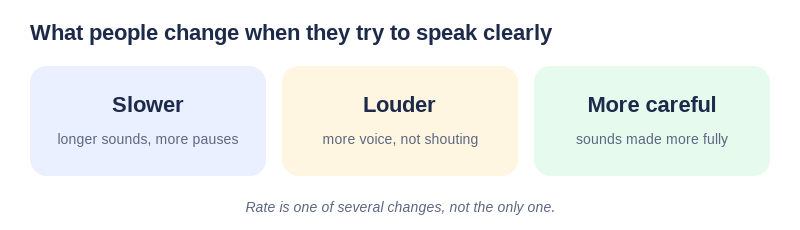
As the tiles show, slowing down is only one of those changes. With training, talkers produced clear speech at normal or conversational rates, and it still increased intelligibility for normal-hearing listeners with simulated hearing losses, in noise, though slightly less than clear speech at slow rates. In studies of how intelligible different talkers were in English conversational speech, overall speaking rate showed either no link with intelligibility or a link for some but not all talkers.4
In a study of 78 speakers whose sentences were mixed with background babble, speaking loudly or clearly improved intelligibility compared with habitual speech, but speaking slowly did not. For the control speakers, slow speech was less intelligible than their habitual speech.19
Where you pause matters too. In a study with 27 normal-hearing young adults, inserting silent pauses at meaningful points in a sped-up narrative brought recall close to the level for the original, unaltered rate, while pauses at random points unrelated to sentence structure gave little or no improvement.16
Who finds fast speech hardest to follow
Hearing loss is common: the NIDCD reports that about one in three people in the US aged 65 to 74 has hearing loss, and nearly half of those older than 75 have difficulty hearing. The NHS lists misunderstanding people, especially in noisy places, and finding it hard to keep up with a conversation among the signs.10,13
In a study of 21 cochlear implant users, slowed sentences were slightly more intelligible than sentences at the original rate, and the slower rate relieved listening effort, particularly the effort that would have lingered after a sentence was over.14
Language matters as well. In one study, non-native listeners judged the same recordings as faster than native listeners did, and the effect was smaller the better they understood the content. In another, fluent non-native listeners gained a large benefit in noise when native talkers used clear speech.17,18
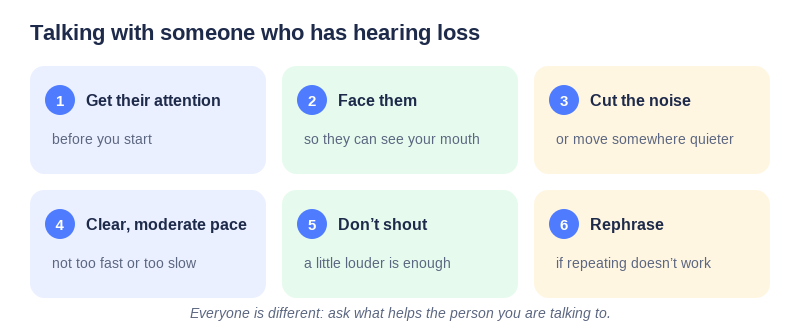
Hearing-loss organisations advise speaking clearly at a moderate pace without yelling, and RNID advises avoiding shouting and speaking either rushed or unnecessarily slow. RNID adds that people with hearing loss differ, so different individuals may need different changes.11,12
Check your own pace
It’s hard to self-assess what rate you’re speaking at, and one university communication guide suggests practising with someone or recording yourself. In a study of ten talkers who did the same speech tasks four times, measures including speaking rate were compared across repetitions, and statistically significant changes can occur from one repetition of a task to the next, especially in a conversational style.22,23
So compare like with like: the same kind of task, in similar conditions, against your own earlier results.
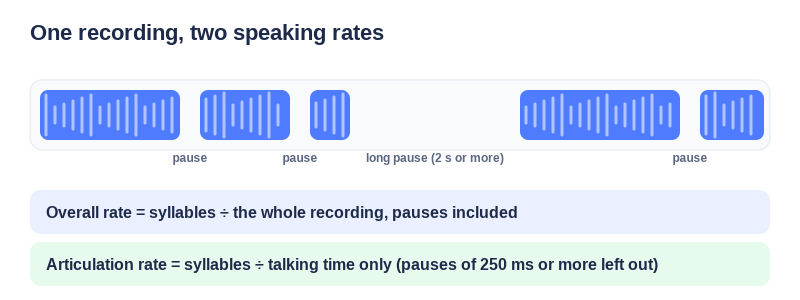
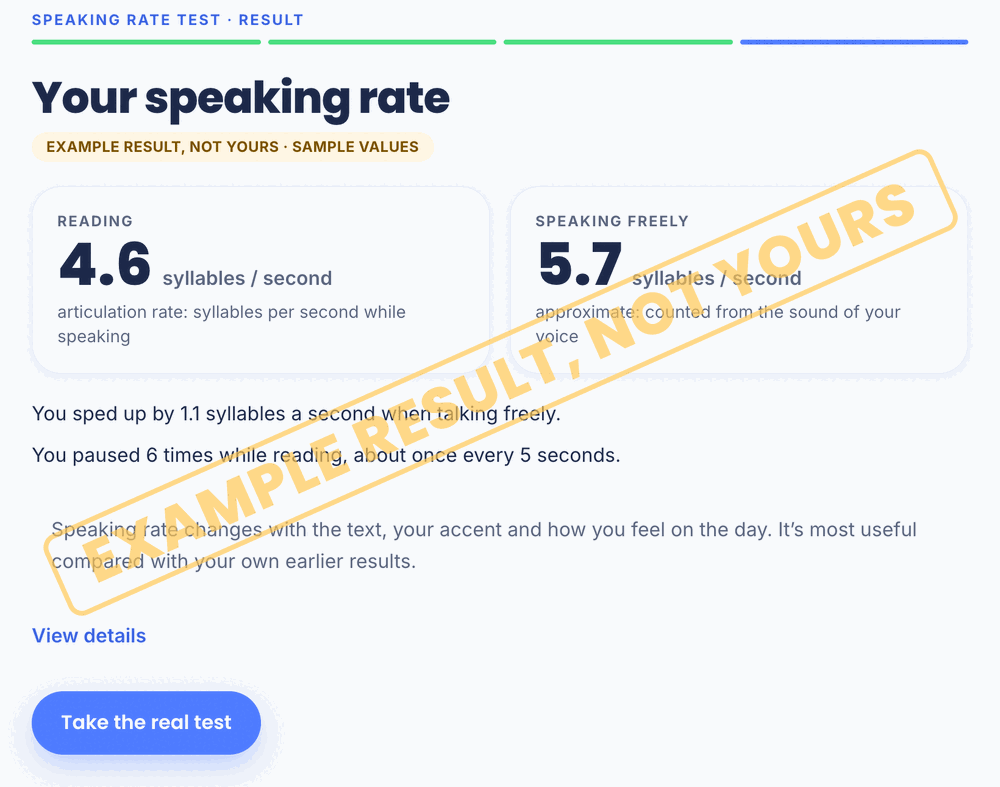
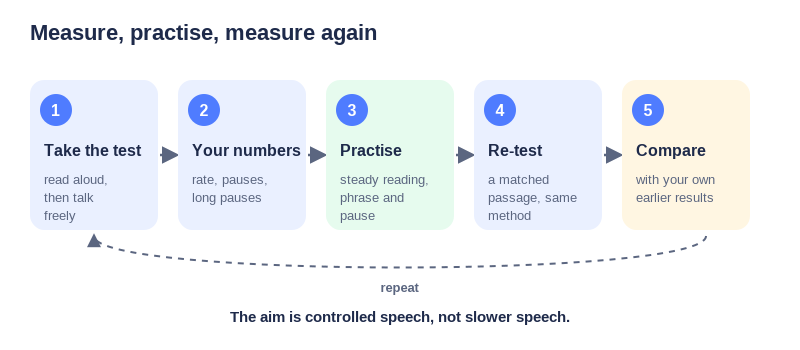
SpeechStep’s free speaking rate test takes about two minutes and needs no account. You read a short passage aloud, then talk freely for 30 seconds, and see each part’s rate in syllables per second side by side; the free-speech number is approximate, and “View details” adds overall rate, articulation rate, words per minute, pauses and long pauses, as the timeline diagram shows. It’s analysed on your device, the recording isn’t saved unless you create an account, and background noise can add or hide syllables. Results are indicative, not a diagnosis, and the test doesn’t identify stuttering, cluttering or any other condition.
Free Speaking Rate Test
Read a short passage aloud, then talk freely for 30 seconds. Analysed on your device; indicative, not a diagnosis.
What helps: phrases, pauses and steady reading
A public-speaking guide describes pauses as vocal punctuation and suggests pausing after complete thoughts to give listeners a little time to think about what you’ve said. In a study of how listeners use prosody to work out sentence structure, timing variation was the most valuable of the three cues tested, for both younger and older adults.21,20
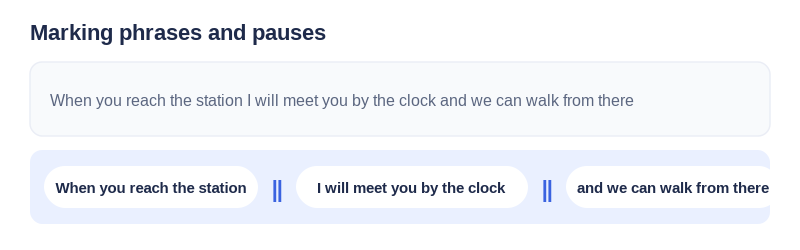
SpeechStep Pacing turns this into practice for teens and adults: steady reading with the passage highlighted at a steady guide pace, phrase pacing with ‖ marks showing where to pause, and pause practice. Feedback is neutral, results are kept by task, and a re-test uses a matched passage with the same method, so you compare with your own earlier results rather than a norm. The first two sessions are free with an account, then Premium. The aim is controlled speech, not slower speech.
- Pause at the end of each complete thought, not in the middle of a phrase.
- Take the hard parts more steadily: names, numbers, technical words and your main point.
- Finish the ends of words before moving on to the next one.
- Face your listener and turn down background noise when you can.
- Record the same paragraph each week and listen back.
- Ask your listener what helps them rather than guessing.
When to see an SLP
A fast rate is not enough on its own: a clinical text on cluttering says that not every speaker with a fast speech rate should be diagnosed with cluttering. ASHA notes that in cluttering the speaker’s measured rate is not always greater than average, but the listener perceives it as rapid.1,8
If someone has difficulty speaking and their speech is slurred or garbled, especially with a face drooping on one side or an arm they can’t lift, these can be signs of a stroke, which is a medical emergency; stroke symptoms usually come on suddenly. The NHS says to call 999 in the UK. For gradual changes to speech that worry you, the NHS advises seeing a GP.6
Elsewhere, call your local emergency number at once.
When to see an SLP
Consider a licensed speech-language pathologist (SLP), called a speech and language therapist in the UK, if people often can’t understand you even when you take more care, if word endings drop off or syllables run together, if you get stuck on sounds or words, or if the way you speak is affecting your work or confidence. An SLP can work out what’s going on and set any goals with you. See a doctor first if speech has changed suddenly. Our find support page explains how to find an SLP through your country’s register.
What SpeechStep can and can’t do
SpeechStep can show your speaking rate and pauses, indicatively and analysed on your device, and give you structured pacing practice you can compare with your own earlier results. It can’t diagnose, assess or treat anything, it doesn’t identify stuttering, cluttering or any other condition, and it doesn’t measure loudness or voice quality. It’s practice, not therapy.
Frequently asked questions
Why do people say I talk too fast?+
Listeners process your words at the same time as you say them, and sped-up speech can take away the processing time they ordinarily have. How fast you sound also depends on the listener: in one study, non-native listeners judged the same recordings as faster than native listeners did. With hearing loss, misunderstanding people in noisy places and finding it hard to keep up with a conversation are common signs.
How do I stop talking too fast?+
Work on pauses and clear sounds, not just speed. A public-speaking guide suggests pausing after complete thoughts to give listeners time to think, and in clear-speech research, talkers trained to speak clearly at conversational rates still increased intelligibility for normal-hearing listeners with simulated hearing losses, in noise. The aim is controlled speech, not slower speech.
Why do I stumble over my words when I talk fast?+
One public-speaking guide warns that talking quickly can make you stumble over your words, and another notes that complex terms are easier to say when you speak slowly. ASHA notes that all speakers are disfluent at times. If you often get stuck on sounds or words, or it’s affecting your confidence, a speech-language pathologist can help work out what’s going on.
Is speaking slowly always clearer?+
Not always. In a study of 78 speakers heard through background babble, speaking loudly or clearly improved intelligibility, but speaking slowly did not, and for the control speakers slow speech was less intelligible than their habitual speech. Research on English conversational speech has also found that overall speaking rate showed either no link with intelligibility or a link for only some talkers.
Is there a normal speaking speed?+
Rate depends on the task and the speaker. In one study, articulation rate in reading was slower than in spontaneous speaking, and in another, a group of speakers from Wisconsin spoke faster than a group from North Carolina. SpeechStep doesn’t set a target rate; compare your results with your own earlier ones.
Does talking fast mean I have cluttering?+
Not on its own: a clinical text on cluttering says not every speaker with a fast speech rate should be diagnosed with cluttering, and ASHA notes that in cluttering the measured rate isn’t always greater than average. A definitive diagnosis of cluttering can only be made by a speech-language pathologist with experience in it. SpeechStep’s speaking rate test is indicative, analysed on your device and not a diagnosis, and it doesn’t identify cluttering or any other condition.
Practise your own speech, one sound at a time
Free with an account: your first practice day is a full session of 14 words, then 5 words a day, with AI feedback on the sounds it supports. SpeechStep is practice, not therapy, and it doesn’t diagnose.
Need a licensed professional? Where to find a speech-language pathologist
References
23 sources from authoritative bodies. Last reviewed November 2026.
- 1.ASHAStuttering, Cluttering, and Fluency — Practice Portal page.
- 2.Language Variation and ChangeArticulation rate across dialect, age, and gender — Peer-reviewed study (PMC full text), 2009.
- 3.The Journal of the Acoustical Society of AmericaBetween-speaker and within-speaker variation in speech tempo of American English — Peer-reviewed study (PMC full text), 2010.
- 4.Language and Linguistics CompassSpeaking and Hearing Clearly: Talker and Listener Factors in Speaking Style Changes — Peer-reviewed review (PMC full text), 2009.
- 5.ASHAStuttering, Cluttering, and Fluency (definitions, prevalence, cluttering vs stuttering, adults) — Practice Portal page.
- 6.NHS (nhs.uk)Dysarthria (difficulty speaking) — Health A to Z page, 2023.
- 7.International Cluttering Association (compiled by K. Scaler Scott, F. Myers, P. Kissagizlis)What is Cluttering? — Information page.
- 8.Routledge (TalkBank copy)van Zaalen, Y. & Reichel, I. An Introduction to Cluttering (Section 5.2.1 Cluttering and tachylalia; Sections 2.2.7, 4.5.1) — Book, 2024.
- 9.National Institute on Aging (NIH)Hearing Loss: A Common Problem for Older Adults — Patient information page, 2023.
- 11.Hearing Loss Association of America (HLAA)Communication Tips: Tips to Hear and Be Heard — Patient organisation tip page, 2025.
- 12.RNID (Royal National Institute for Deaf People)How to communicate with someone who is deaf or has hearing loss — Charity information page, 2026.
- 13.NHS (nhs.uk)Hearing loss — Patient information page, 2025.
- 14.Ear and Hearing (Wolters Kluwer, open access); PMC8005496Slower Speaking Rate Reduces Listening Effort Among Listeners With Cochlear Implants (Winn & Teece) — Journal article, 2021.
- 15.Journal of the Acoustical Society of America (JASA Express Letters); PMC6377055 (checker reads the abstract)Recognition of time-compressed speech does not predict recognition of natural fast-rate speech by older listeners (Gordon-Salant, Zion & Espy-Wilson) — Journal article (abstract excerpts), 2014.
- 16.Trends in Hearing (SAGE, open access); PMC10637151Strategic Pauses Relieve Listeners from the Effort of Listening to Fast Speech (O'Leary, Neukam, Hansen, Kinney, Capach, Svirsky & Wingfield) — Journal article, 2023.
- 17.Frontiers in Psychology (open access, CC BY); PMC5487441Foreign Languages Sound Fast: Evidence from Implicit Rate Normalization (Bosker & Reinisch) — Journal article, 2017.
- 18.Journal of the Acoustical Society of America; PMC3253601 (checker reads the abstract)Bidirectional clear speech perception benefit for native and high-proficiency non-native talkers and listeners: Intelligibility and accentedness (Smiljanić & Bradlow) — Journal article (abstract excerpts), 2011.
- 19.Journal of Speech, Language, and Hearing Research (ASHA); NIH author manuscript PMC5564324Impact of Clear, Loud, and Slow Speech on Scaled Intelligibility and Speech Severity in Parkinson’s Disease and Multiple Sclerosis (Tjaden, Sussman & Wilding) — Journal article, 2014.
- 20.Experimental Aging Research (Taylor & Francis); NIH author manuscript PMC2867101Components of Speech Prosody and Their Use in Detection of Syntactic Structure by Older Adults (Hoyte, Brownell & Wingfield) — Journal article, 2009.
- 21.University of Tennessee, Knoxville, Tennessee Online Public Speaking Center (TOPS)Vocal Delivery — University teaching resource page.
- 22.Massachusetts Institute of Technology, Biological Engineering Communication Lab (CommKit)Public Speaking: Verbal — University teaching resource page.
- 23.Journal of the Acoustical Society of America; PMC10990565 (checker reads the abstract)Within-talker and within-session stability of acoustic characteristics of conversational and clear speaking styles (Ferguson, Morgan & Hunter) — Journal article (abstract excerpts), 2024.
Keep reading
How to Talk Slower
Practical ways to steady your pace without sounding unnatural.
Read →Pausing When Speaking
Where to pause, and why well-placed pauses help listeners.
Read →Speaking Clearly to People with Hearing Loss
What hearing-loss organisations suggest, from facing people to rephrasing.
Read →Controlled Speech, Not Slower Speech
Why clear, steady speech matters more than simply slowing down.
Read →