Speaking Rate Calculator: Work Out Your Words per Minute
To work out your speaking rate, count what you said and divide by the time it took: words ÷ minutes gives words per minute, syllables ÷ seconds gives syllables per second. Decide whether pauses count, then compare the result with your own earlier recordings.
The two formulas
Speaking rate can be counted in words or in syllables. One study measured speaking rate in words per minute, as an overall measure that includes pause time, and another calculated it as the number of syllables divided by the total duration.10,8
So the two formulas are: words per minute = words spoken ÷ minutes, and syllables per second = syllables spoken ÷ seconds. If you said 90 words in 40 seconds, that’s 90 ÷ 40 × 60 = 135 words per minute. If the same 40 seconds held 150 syllables, that’s 150 ÷ 40 = 3.75 syllables per second. These are worked examples of the arithmetic only, not a typical or target pace.
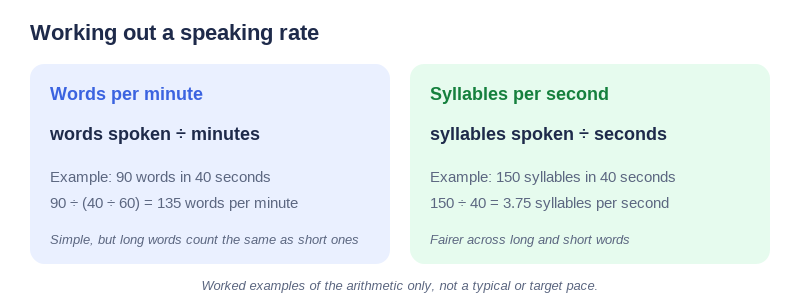
To turn a per-second figure into a per-minute one, multiply by 60; to go the other way, divide by 60. Pick one unit and keep it when you compare results over time.
Step by step with your own recording
- 1Record yourself for 30 to 60 seconds in a quiet room, either reading a passage aloud or talking freely on one topic. Note which you did.
- 2Write out exactly what you said, and decide before you count whether repeated words and fillers such as “um” are included.
- 3Count the words, or count the syllables. The syllable counter will do this for pasted text.
- 4Time the recording from your first word to your last.
- 5Divide: words ÷ minutes, or syllables ÷ seconds.
- 6Write the result down with the date, the task and the room, so your next result is comparable.
MIT’s communication guidance on public speaking notes that it’s hard to self-assess the rate you’re speaking at, and suggests practising with someone or recording yourself.12
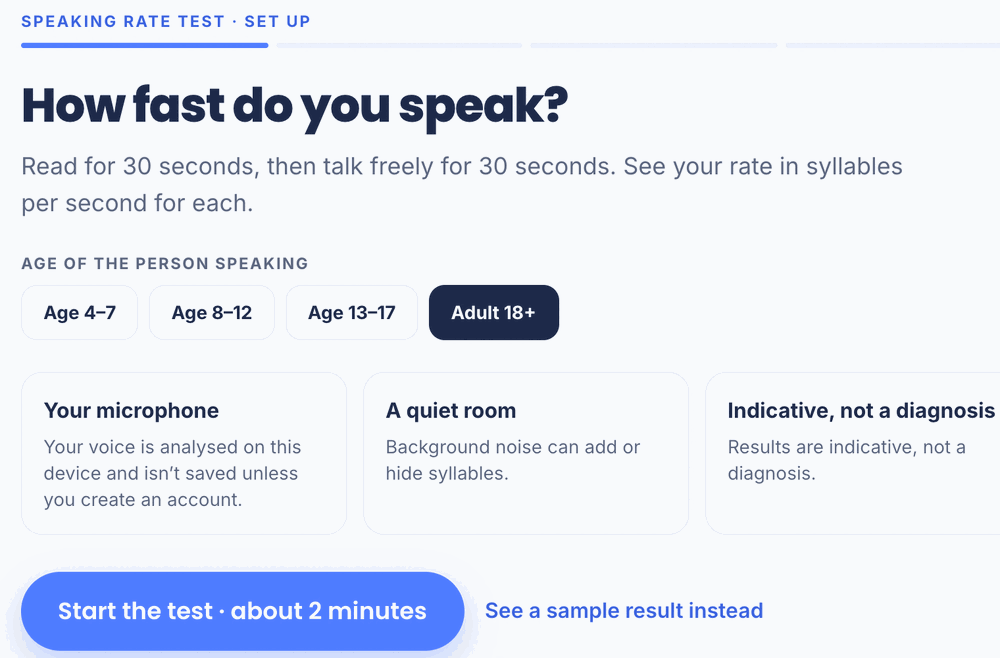
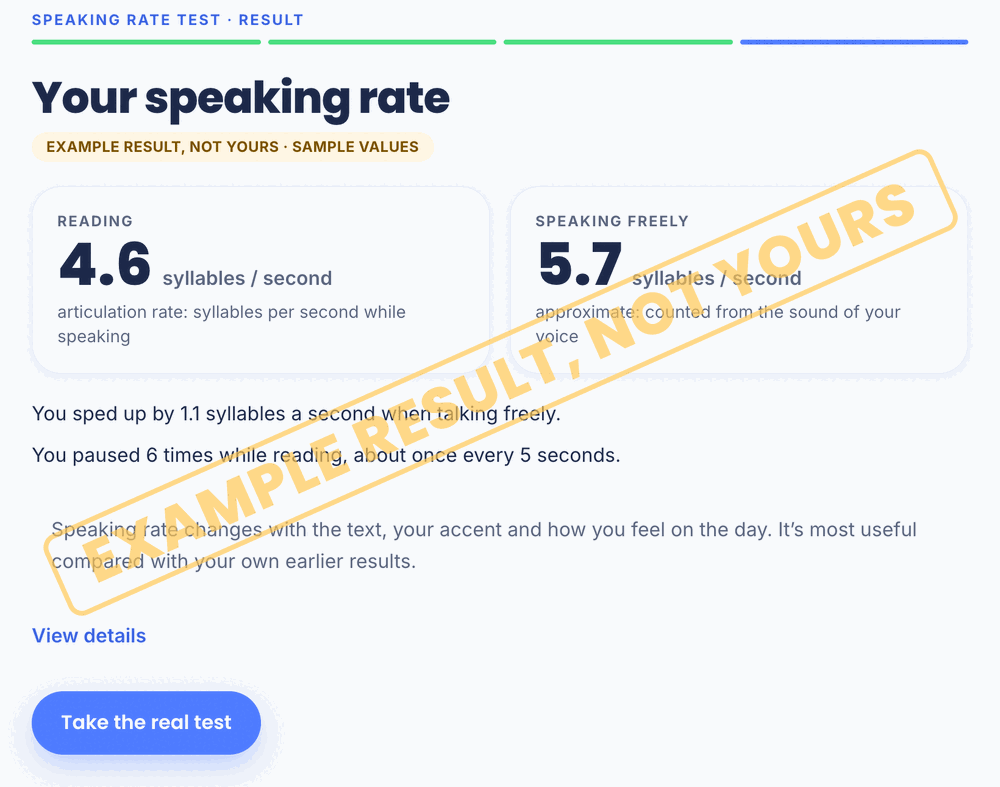
If you’d rather not count by hand, SpeechStep’s free speaking rate test does the counting. It takes about 2 minutes with no account: you read a short passage aloud for about 30 seconds, then talk freely for 30 seconds on a prompt, and it shows each part’s rate in syllables per second side by side, with the difference between them. It’s analysed on your device, the recording isn’t saved unless you create an account, and the result is indicative, not a diagnosis.
Pauses in or out: overall rate vs articulation rate
In one study, speech rate was the total number of syllables divided by total speaking time including pauses, and articulation rate was divided by total speaking time without pauses. By leaving out pause time, articulation rate conveys more closely the pace at which speech segments are actually produced.11,3
Studies define a pause differently. One defined a pause as a silent period of 200 ms or more between words, another set a minimum pause threshold of 300 ms, and another describes investigators deleting pauses longer than 250 ms when measuring articulation rate. The authors of that last study note that results have been mixed, partly due to differences in what was measured and how the measurements were made.7,10,9
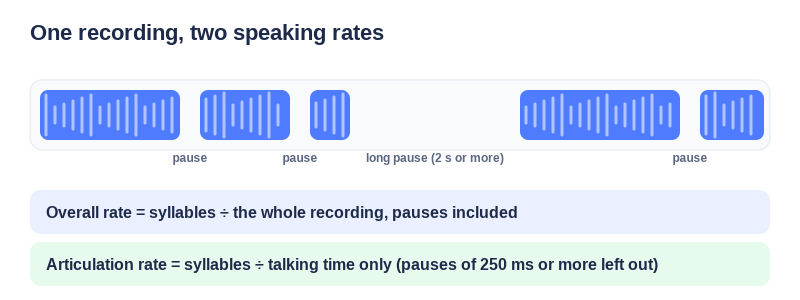
As the diagram shows, SpeechStep’s speaking rate test reports both. Under “View details” you’ll see overall rate (pauses included), articulation rate (pauses of 250 ms or more left out), words per minute, pauses, and long pauses of 2 seconds or more. Whichever you use, compare like with like: an articulation rate and an overall rate are different measures.
Why syllables are fairer than words
The number of syllables in a word is decided by its number of vowel sounds, and one syllable can have more than one vowel letter.2
Words vary in length, so two scripts with the same number of words can take noticeably different times to say. Counting syllables takes that length into account.
A study of 192 speakers of two varieties of American English defined speech tempo as the articulation rate excluding pauses, measured in syllables per second. A cross-language study noted that syllables are much less prone than phonemes (individual speech sounds) to complete deletion in casual speech, allowing more robust estimates of speech rate.3,5
In recordings of 170 native adult speakers of 17 languages, each reading a standardised set of texts, languages differed widely in speech rate yet encoded similar information rates.5
If you speak more than one language, compare your results within the same language rather than across languages.
Turning a rate into a script length
Once you know a rate, you can run it backwards: time = syllables ÷ syllables per second. A 750-syllable script at 3 syllables per second takes 750 ÷ 3 = 250 seconds, a little over four minutes, before any pauses. That’s arithmetic at a stated pace, not a typical or target pace.
SpeechStep’s words-to-minutes calculator does this from syllables rather than words, adding a short pause at each sentence end. It also works the other way, from a time to a word count. You can pick one of three pace settings, enter a custom pace, or use your own measured rate from the speaking rate test, and your text stays in the browser. Treat any estimate as a starting point, then rehearse out loud.
Free Words-to-Minutes Calculator
How long your script takes at your pace, worked out from syllables.
An article in Toastmaster magazine on managing speaking time says to practise out loud, not in your head. It describes a speaker who practises with a stopwatch, and mentions having pre-planned content to cut.1
Compare with your own results
In a study of 192 speakers of two varieties of American English, articulation rate in reading was slower than in speaking. In a study of 20 young and 20 old native Hungarian speakers in four speech styles, speech style had a higher effect on temporal parameters than speakers’ age. In large corpora of conversational telephone speech in English and Chinese, people tended to use slower speech rates when talking with strangers or discussing certain topics.3,11,4
In one study, a single male talker said the sentence “Jean bought a bead at the store” at 5.22 syllables per second in its conversational version and 2.09 syllables per second in its clear version. In another, ten talkers performed a set of three speech tasks four times in each of two speaking styles, with measures including speaking rate, and statistically significant changes could occur from one repetition of a speech task to the next, especially in the conversational style.8,13
- Use the same task each time: the same passage, or the same kind of free-talk prompt.
- Record in the same quiet room with the same device, because background noise can add or hide syllables.
- Keep the same unit and the same pause rule.
- Look at the trend across several recordings rather than one number.
From numbers to practice
A review of clear speech research reports that talkers can be trained to produce clear speech at conversational speaking rates, and that this increased intelligibility for normal-hearing listeners with simulated hearing losses, in noise, to a slightly smaller degree than clear speech at slow rates. In studies of English conversational speech intelligibility, overall speaking rate showed either no correlation with intelligibility or a correlation for some but not all talkers.6
A rate number is information about how you spoke on one task, not a goal. If you want to practise, SpeechStep Pacing (for teens and adults, on the web) offers steady reading, where a passage is highlighted at a steady guide pace, phrase pacing and pause practice. A free account includes the first two pacing sessions, then Premium. Results are kept by task, and a re-test uses a matched passage with the same method so the change is comparable. The aim is controlled speech, not slower speech.
What SpeechStep can and can’t do
The speaking rate test is indicative, analysed on your device and not a diagnosis. It doesn’t identify stuttering, cluttering or any other condition, and SpeechStep doesn’t measure loudness or voice quality. The free-speech number is approximate. If you’re worried about your speech, a speech-language pathologist (SLP) is the professional to ask, and our find-support page explains how to find one through your country’s register.
Frequently asked questions
How do you calculate speaking rate?+
Count what you said and divide by how long it took: words ÷ minutes gives words per minute, and syllables ÷ seconds gives syllables per second. Decide first whether pauses count, because overall rate includes pause time and articulation rate leaves it out.
How do I calculate words per minute when speaking?+
Record yourself, count the words, and divide by the length of the recording in minutes. For example, 90 words in 40 seconds is 90 ÷ 40 × 60 = 135 words per minute; that’s arithmetic, not a typical or target pace. Use the same task each time so your results are comparable.
How do I convert words per minute to syllables per second?+
Words and syllables are different units, so you need the syllable count itself. The number of syllables in a word is decided by its number of vowel sounds; count the syllables in your transcript (the syllable counter can do this) and divide by the seconds. If you already have syllables per minute, divide by 60.
Should pauses count when working out speaking rate?+
It depends on what you want to know. Overall rate includes pause time, while articulation rate leaves it out and conveys more closely the pace at which speech segments are produced. Studies use different cut-offs for a pause, such as 200, 250 or 300 ms, so note which rule you used.
How many words is a 5-minute speech?+
It depends on your pace and how long your words are, which is why the words-to-minutes calculator works from syllables. Time a rehearsal of a short section, work out your own rate, then scale up. An article in Toastmaster magazine says to practise out loud, not in your head, and mentions practising with a stopwatch and having pre-planned content to cut.
Is there a target speaking rate I should aim for?+
SpeechStep doesn’t set one. In one study, articulation rate in reading was slower than in speaking, and in studies of English conversational speech, overall speaking rate showed either no correlation with intelligibility or a correlation for only some talkers. Compare with your own earlier results, and if you have concerns about your speech, ask a speech-language pathologist.
Practise your own speech, one sound at a time
Free with an account: your first practice day is a full session of 14 words, then 5 words a day, with AI feedback on the sounds it supports. SpeechStep is practice, not therapy, and it doesn’t diagnose.
Need a licensed professional? Where to find a speech-language pathologist
References
13 sources from authoritative bodies. Last reviewed November 2026.
- 1.Toastmasters International (Toastmaster magazine)Manage Your Speaking Time — Magazine article, February 2025, 2025.
- 2.VOA Learning EnglishHow to Count Syllables — English-learning lesson.
- 3.The Journal of the Acoustical Society of AmericaBetween-speaker and within-speaker variation in speech tempo of American English — Peer-reviewed study (PMC full text), 2010.
- 4.Interspeech 2006 (ISCA)Towards an integrated understanding of speaking rate in conversation — Peer-reviewed conference paper, 2006.
- 5.Science AdvancesDifferent languages, similar encoding efficiency: Comparable information rates across the human communicative niche — Peer-reviewed study (PMC full text), 2019.
- 6.Language and Linguistics CompassSpeaking and Hearing Clearly: Talker and Listener Factors in Speaking Style Changes — Peer-reviewed review (PMC full text), 2009.
- 7.Journal of Speech, Language, and Hearing Research (ASHA); NIH author manuscript PMC5564313Acoustics of Clear Speech: Effect of Instruction (Lam, Tjaden & Wilding) — Journal article, 2012.
- 8.JASA Express Letters (open access, CC BY); NIH author manuscript PMC11303017Clear speech promotes speaking rate normalization (Kahloon, Shorey, King & Stilp) — Journal article, 2023.
- 9.Journal of Communication Disorders (Elsevier); NIH author manuscript PMC4081543Differences of articulation rate and utterance length in fluent and disfluent utterances of preschool children who stutter (Chon, Sawyer & Ambrose) — Journal article, 2012.
- 10.PLOS ONE (open access); PMC4720472Profiling Speech and Pausing in Amyotrophic Lateral Sclerosis (ALS) and Frontotemporal Dementia (FTD) (Yunusova et al.) — Journal article, 2016.
- 11.Journal of the Acoustical Society of America (JASA Express Letters); author copy in the Hungarian Academy of Sciences repository (REAL)Temporal characteristics of speech: The effect of age and speech style (Bóna) — Journal article, 2014.
- 12.Massachusetts Institute of Technology, Biological Engineering Communication Lab (CommKit)Public Speaking: Verbal — University teaching resource page.
- 13.Journal of the Acoustical Society of America; PMC10990565 (checker reads the abstract)Within-talker and within-session stability of acoustic characteristics of conversational and clear speaking styles (Ferguson, Morgan & Hunter) — Journal article (abstract excerpts), 2024.
Keep reading
Words per Minute When Speaking
What research says about speaking rates, by task and group.
Read →Articulation Rate vs Speaking Rate
Why leaving pauses in or out changes the number.
Read →Speech Length Chart
Script lengths and timings worked out as arithmetic.
Read →Speech Pace Test
Measure your reading and free-talk pace side by side.
Read →