Speech Pace Test: How Fast Do You Speak?
SpeechStep’s free speaking rate test takes about 2 minutes: read a short passage aloud, then talk freely for 30 seconds. It shows each part’s rate in syllables per second and is analysed on your device. Results are indicative, not a diagnosis; compare them with your own earlier results.
Take the test
The free speaking rate test takes about 2 minutes and needs no account. Choose your age group, then record two short parts: reading a short passage aloud for about 30 seconds, and talking freely for 30 seconds on a prompt.
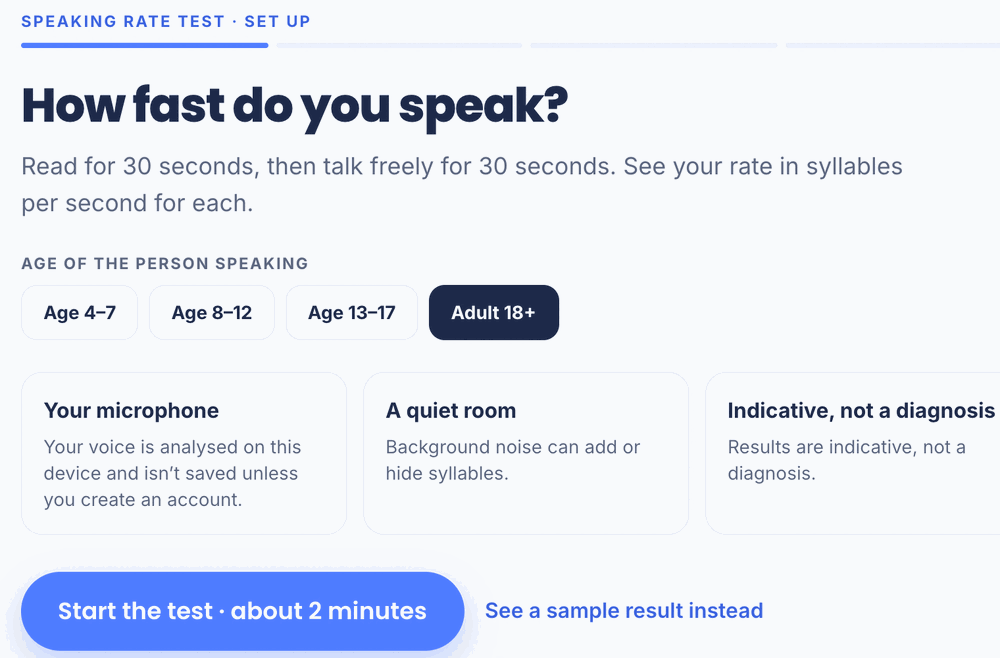
Your recording is analysed on your device and isn’t saved unless you create an account. The result is indicative, not a diagnosis. If you’d like to see what a result looks like before you record, the test includes a sample result stamped “example result, not yours”.
Free Speaking Rate Test
Read a short passage aloud, then talk freely for 30 seconds. Analysed on your device; indicative, not a diagnosis.
What the test measures
Researchers describe speech rate as having two components: the rate at which speech is produced, and the duration of pauses between words. Overall speaking rate is measured in words or syllables per minute or second, including disfluencies and pauses shorter than 1–2 seconds. Articulation rate leaves pauses out; one study defined it as syllables per second, excluding pauses, and noted that this conveys more closely the pace at which speech segments are actually produced.9,3
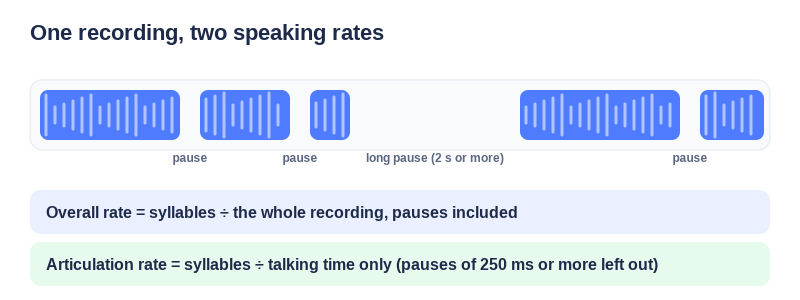
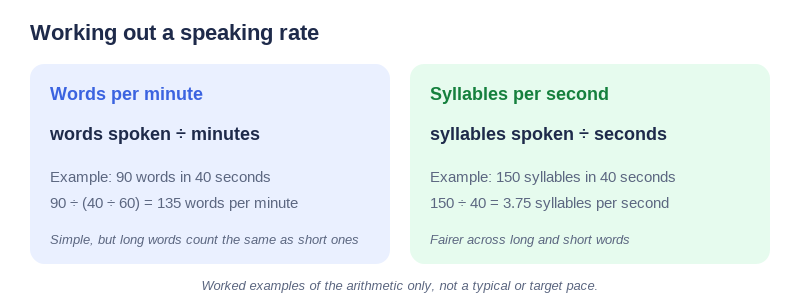
In the test, “View details” shows both, as the first diagram shows: overall rate with pauses included, and articulation rate leaving out pauses of 250 ms or more, with pauses of 2 seconds or more counted as long pauses. The main result is in syllables per second, and words per minute is there under “View details” too. The second diagram works through the arithmetic for both units at a made-up pace, not a typical or target one.
Syllables are counted by vowel sounds, not vowel letters. In casual speech, syllables are much less prone than individual speech sounds to complete deletion, which allows more robust estimates of speech rate.1,5
Reading aloud and talking freely give different numbers
In a study of 192 speakers of two varieties of American English, ranging in age from children to older adults, articulation rate in reading was slower than in spontaneous speaking.3
In a study of 20 young and 20 older native Hungarian speakers, reading aloud was the fastest of four speaking styles in both age groups, and speaking style had a greater effect on timing than age did.10
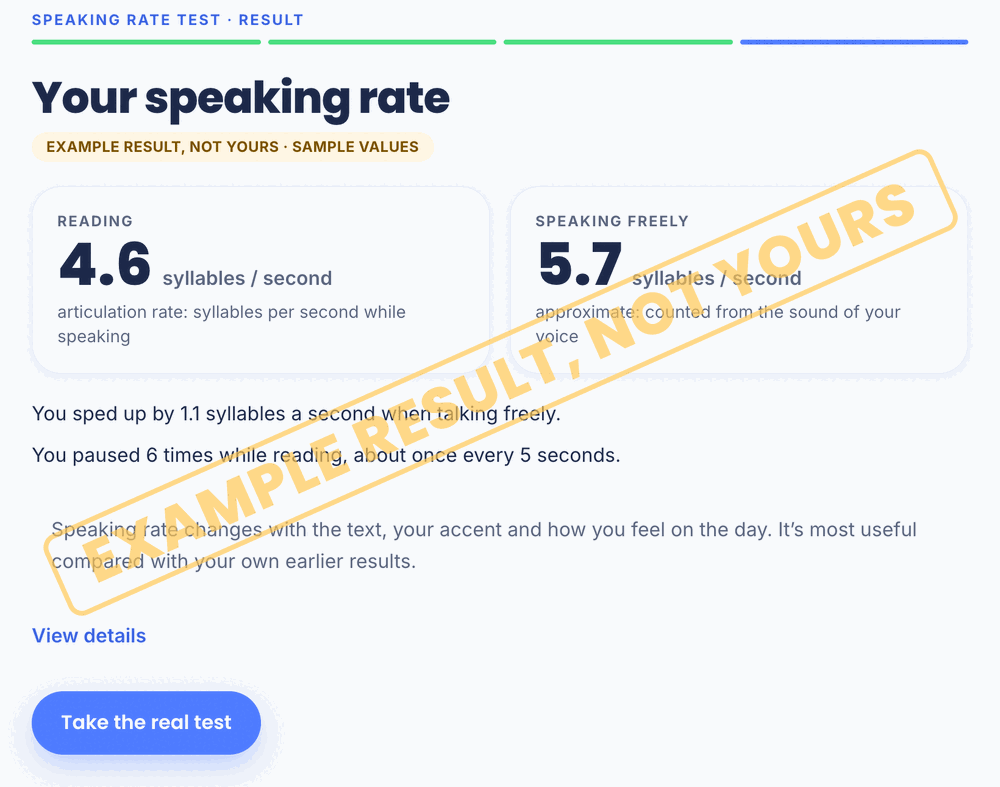
So expect your two numbers to differ, and don’t expect the direction to be the same for everyone. The useful thing to watch is the gap between your own two parts, and how it changes over time. Your result shows the reading rate and the free-speech rate side by side, with the difference between them. The free-speech number is labelled approximate, so treat small changes in it with caution.
How to read your result
In one study of articulation rate, a group of speakers from Wisconsin spoke significantly faster than a group from North Carolina, and young adults read faster than older adults in both regions.2
In large collections of conversational telephone speech in English and Chinese, people tended to use slower speech rates when talking with strangers or discussing certain topics.4
In studies comparing how well listeners understood different talkers’ English conversational speech, overall speaking rate showed either no correlation with intelligibility, or a correlation for some but not all talkers.6
So there is no single number to aim for, and a faster rate doesn’t simply mean harder-to-follow speech. The fairest comparison is with yourself: the same task, the same or a matched passage, measured the same way, a few weeks apart.
Getting a fair reading: quiet room, same passage, same time of day
In one lab study, ten talkers performed a set of three speech tasks four times in each speaking style, and statistically significant changes occurred from one repetition of a task to the next, especially in the conversational style.12
A university public-speaking guide notes that it’s hard to self-assess the rate you’re speaking at, and suggests practising with someone or recording yourself.11
So a single result can move around even when nothing else has changed. These steps keep your re-tests as comparable as possible.
- Record in a quiet room: background noise can add or hide syllables.
- Use the same passage, or a matched one, each time you re-test.
- Test at a similar time of day, when you’re about as rested as last time.
- Read the passage through once before recording, so the first run isn’t also your rehearsal.
- Keep the microphone at the same distance from your mouth.
- Look at the trend across several results rather than one reading.
What the test can’t tell you
A rate number on its own can’t tell you whether you have a speech or fluency condition. The test doesn’t identify stuttering, cluttering or any other condition; its result is indicative, analysed on your device and not a diagnosis.
The International Cluttering Association describes cluttering as a fluency disorder with a rate that is perceived to be “abnormally rapid, irregular or both for the speaker”, although measured syllable rates “may not exceed normal limits”.8
The NHS lists difficulty speaking, where speech may be slurred or garbled, a face drooping on one side, or being unable to lift both arms and keep them there as possible signs of a stroke, which is a medical emergency; it says to call 999, and that stroke symptoms usually come on suddenly.7
If speech changes suddenly, call your local emergency number at once. If your speech worries you, or people often struggle to understand you, a licensed speech-language pathologist (SLP) is the right next step, and our find-support page explains how to look one up through your country’s register.
From test to practice
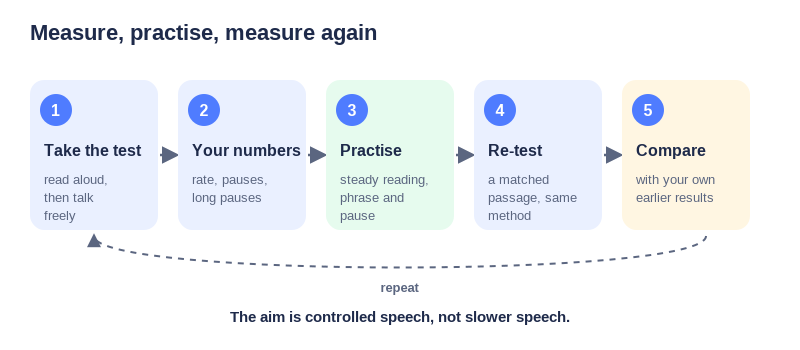
If you’d like to work on how you pace your speech, SpeechStep Pacing turns the test into a practice loop: steady reading, phrase pacing and pause practice, then a re-test on a matched passage with the same method. The aim is controlled speech, not slower speech.
Research on clear speech has shown that talkers can be trained to produce clear speech at conversational speaking rates, and that this increased intelligibility for normal-hearing listeners with simulated hearing losses, in noise, to a slightly smaller degree than clear speech at slow rates.6
What SpeechStep can and can’t do
The speaking rate test measures your rate and pauses on your device and gives an indicative result, not a diagnosis, best compared with your own earlier results. It doesn’t identify stuttering, cluttering or any other condition, doesn’t measure loudness or voice quality, and isn’t therapy. Pacing practice needs a free account; the first two sessions are free, then Premium. If you opt in to human review, an authorised SpeechStep reviewer may listen to eligible recordings.
Frequently asked questions
How do I test how fast I speak?+
Take SpeechStep’s free speaking rate test: read a short passage aloud for about 30 seconds, then talk freely for 30 seconds. It takes about 2 minutes, needs no account and is analysed on your device. The result is indicative, not a diagnosis.
Is words per minute or syllables per second better for speaking speed?+
The speaking rate test shows both, with syllables per second as the main result; it is indicative, analysed on your device and not a diagnosis. Syllables are counted by vowel sounds, and in casual speech they are much less prone than individual speech sounds to complete deletion, which allows more robust estimates of speech rate.
Why is my reading rate different from my talking rate?+
The task changes the rate. In a study of 192 American English speakers, articulation rate in reading was slower than in spontaneous speaking, while a study of native Hungarian speakers found reading aloud was the fastest of four styles. On the speaking rate test, which is indicative, analysed on your device and not a diagnosis, watch the gap between your own two parts over time.
What is a normal speaking pace?+
There isn’t one number that fits everyone. Studies have found rate differs by region and age, and that people tend to speak more slowly with strangers or on certain topics. The most useful comparison is with your own earlier results on the same task.
Can a speech pace test tell if I stutter or clutter?+
No. SpeechStep’s test is indicative, analysed on your device and not a diagnosis, and it doesn’t identify stuttering, cluttering or any other condition. The International Cluttering Association notes that in cluttering, measured syllable rates may not exceed normal limits even though the rate is perceived as abnormally rapid. If you’re concerned, a licensed speech-language pathologist can assess your speech.
Why did my result change when I took the test again?+
In one lab study, significant changes appeared between repetitions of the same speech task, especially in the conversational style. Background noise can also add or hide syllables, so re-test in a quiet room with the same passage. The result is indicative, analysed on your device and not a diagnosis.
Practise your own speech, one sound at a time
Free with an account: your first practice day is a full session of 14 words, then 5 words a day, with AI feedback on the sounds it supports. SpeechStep is practice, not therapy, and it doesn’t diagnose.
Need a licensed professional? Where to find a speech-language pathologist
References
12 sources from authoritative bodies. Last reviewed November 2026.
- 1.VOA Learning EnglishHow to Count Syllables — English-learning lesson.
- 2.Language Variation and ChangeArticulation rate across dialect, age, and gender — Peer-reviewed study (PMC full text), 2009.
- 3.The Journal of the Acoustical Society of AmericaBetween-speaker and within-speaker variation in speech tempo of American English — Peer-reviewed study (PMC full text), 2010.
- 4.Interspeech 2006 (ISCA)Towards an integrated understanding of speaking rate in conversation — Peer-reviewed conference paper, 2006.
- 5.Science AdvancesDifferent languages, similar encoding efficiency: Comparable information rates across the human communicative niche — Peer-reviewed study (PMC full text), 2019.
- 6.Language and Linguistics CompassSpeaking and Hearing Clearly: Talker and Listener Factors in Speaking Style Changes — Peer-reviewed review (PMC full text), 2009.
- 7.NHS (nhs.uk)Dysarthria (difficulty speaking) — Health A to Z page, 2023.
- 8.International Cluttering Association, Clinical Issues Committee (van Zaalen, Myers, Ward, Bennett)Cluttering Assessment — Clinical guideline page.
- 9.Journal of Communication Disorders (Elsevier); NIH author manuscript PMC4081543Differences of articulation rate and utterance length in fluent and disfluent utterances of preschool children who stutter (Chon, Sawyer & Ambrose) — Journal article, 2012.
- 10.Journal of the Acoustical Society of America (JASA Express Letters); author copy in the Hungarian Academy of Sciences repository (REAL)Temporal characteristics of speech: The effect of age and speech style (Bóna) — Journal article, 2014.
- 11.Massachusetts Institute of Technology, Biological Engineering Communication Lab (CommKit)Public Speaking: Verbal — University teaching resource page.
- 12.Journal of the Acoustical Society of America; PMC10990565 (checker reads the abstract)Within-talker and within-session stability of acoustic characteristics of conversational and clear speaking styles (Ferguson, Morgan & Hunter) — Journal article (abstract excerpts), 2024.
Keep reading
How Fast Do I Talk?
What the research says about speaking rate, task by task.
Read →Speaking Rate Explained
What speaking rate is and what changes it.
Read →Articulation Rate vs Speaking Rate
Why leaving pauses out gives a different number.
Read →SpeechStep Pacing
Measured practice for controlled, clear speech.
Read →