How SpeechStep Is Different From English-Learning and Public-Speaking Apps
English-learning apps help you speak English. Public-speaking apps help you deliver talks. SpeechStep helps you practise one specific part of how you speak, such as an S sound or your speaking pace, and shows whether that practice is changing anything. It is practice, not therapy.
The short answer
Most speaking apps fall into two groups. English-learning apps help people become better speakers of English. Public-speaking apps help people deliver talks, interviews and meetings. SpeechStep does something narrower: it helps you practise one specific part of how you speak, and measure whether that practice is working.
That narrower job is the point. A score for “how well you speak English” or “how good your presentation was” can’t tell a parent whether their child’s S sound is changing, or tell an adult whether their pauses are landing where listeners need them.
Three kinds of speaking app
| English-learning apps | Public-speaking apps | SpeechStep | |
|---|---|---|---|
| Main goal | Speak English more fluently | Deliver talks and conversations | Practise a specific part of how you speak |
| The problem you bring | “I struggle with English” | “I want to present better” | “My child can’t say S yet” or “I rush my words” |
| What you practise | Vocabulary, grammar, conversation, pronunciation | Presentations, interviews, role-play | Target sounds in words; steady reading, phrases and pauses |
| What is measured | English level, pronunciation, fluency | Delivery: pace, filler words, energy | Feedback on the sounds its checks support; speaking rate and pauses |
| Compared with | A target accent or level | A delivery score | Your own earlier results |
How the three groups differ. A category summary in SpeechStep’s words, not a rating of any product. Checked 8 November 2026.
These groups overlap at the edges. Some English apps give feedback on individual sounds, and some public-speaking apps show words per minute. The difference is what the feedback is for: English proficiency, presentation performance, or progress on one speech goal you chose.
What other apps say they are for
Here is how some well-known apps describe themselves on their own websites, read on 8 November 2026. We quote their words so the comparison is fair; we haven’t tested these apps and make no claim about how well they work.
| Product | Group | How it describes itself | Source |
|---|---|---|---|
| ELSA Speak | English learning | “#1 AI English Speaking App for Fluency and Confidence” | elsaspeak.com |
| Stimuler | English learning | “World’s fastest way to Speak English better!” | stimuler.tech |
| BoldVoice | English accent | “Speak English like a pro” | boldvoice.com |
| Orai | Public speaking | “Speak with confidence. Every time.” | orai.com |
| Speeko | Public speaking | “Speak with confidence.” | speeko.co |
| Yoodli | Communication skills | “The AI Platform for Human Skills.” | yoodli.ai |
Each product’s own headline, from its website on 8 November 2026. Product names are trademarks of their owners; SpeechStep isn’t affiliated with these companies.
None of these is a worse choice for its own job. If you want to learn English, an English app fits. If you want to rehearse a talk, a public-speaking app fits. SpeechStep fits when you want to work on one thing in how you speak, and see it measured.
About this comparison
Product names are trademarks of their owners. SpeechStep isn’t affiliated with these companies. Descriptions are each company’s own words from its website on 8 November 2026 and may have changed; tell us at support@speechstep.com if anything here is out of date.
What “measurable practice” means at SpeechStep
Speech Sounds: a child practising S
A parent picks the sound, and the child practises it in words chosen by age and position in the word. On the sounds its checks support, the AI says when another sound took the target’s place, or that it heard the sound in place; when it isn’t confident, it asks the child to try again rather than guess. Over days, the parent sees the attempts and feedback for that one sound.
SpeechStep Pacing: an adult who rushes
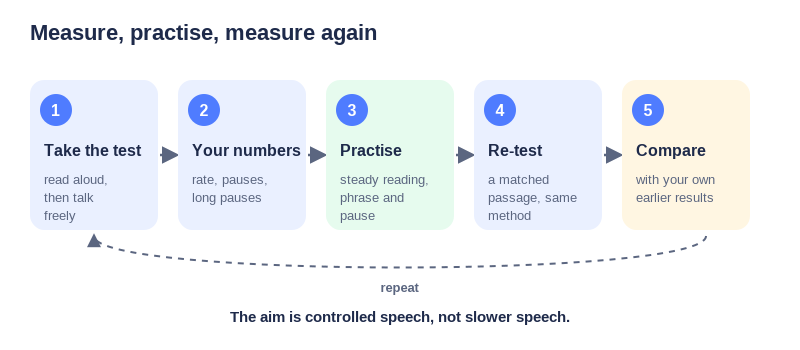
An adult takes the free speaking rate test, then practises steady reading and phrases with pause marks. A re-test uses a matched passage measured the same way, so the change in rate and pauses can be compared with their own first result.
Free Speaking Rate Test
Read for 30 seconds, then talk freely for 30 seconds. Analysed on your device; indicative, not a diagnosis.
Clear-speech research is one reason pace is treated as only part of clarity: talkers trained to speak clearly at conversational rates still helped listeners with simulated hearing losses in noise, a little less than clear speech at slow rates.1
One platform, separate checks
Speech Sounds and SpeechStep Pacing share an account, recording and progress tracking, but they are measured separately and never combined into one score. A check built for the S sound says nothing about speaking pace, and a pace measure says nothing about how a sound is made.
SpeechStep’s AI feedback covers only the sounds and ages it supports today, and the speaking rate test is indicative, analysed on your device and not a diagnosis. Neither identifies a lisp, stuttering, cluttering or any other condition.
When something else fits better
- To learn English or prepare for an English test: an English-learning app or course
- To rehearse presentations, interviews or sales calls: a public-speaking or communication app
- To find out whether there is a speech disorder, or to get treatment: a speech-language pathologist (SLP)
- If speech has changed suddenly: a doctor or emergency services first
When to see an SLP
If you or your child have ongoing difficulty being understood, or speech that stutters, clutters or has changed, a speech-language pathologist can assess it. SpeechStep can be practice alongside their advice.
Frequently asked questions
Is SpeechStep an English-learning app?+
No. It doesn’t teach vocabulary, grammar or English conversation, and it never asks anyone to change their accent. You choose the English you speak (US, UK, Indian or Australian) and practise a specific sound, or your pace, within it.
Is SpeechStep a public-speaking app?+
No. It doesn’t score presentations, filler words or confidence. SpeechStep Pacing measures your speaking rate and pauses, gives you reading and pause exercises, and compares each re-test with your own earlier results.
Is SpeechStep speech therapy?+
No. SpeechStep is practice, not therapy, and it doesn’t diagnose. A speech-language pathologist (SLP) can assess speech, diagnose and plan treatment; SpeechStep can be practice alongside that.
Who is SpeechStep for?+
Parents whose child is practising speech sounds such as S, R or TH (the parent holds the account), teens through a parent’s account, and adults practising their own speech sounds or their speaking pace.
How do I know if practice is working?+
Each practice area measures one thing the same way each time: feedback on the sounds its checks support, or your rate and pauses on matched tasks. You compare with your own earlier results rather than with a score for “good speaking”.
Practise your own speech, one sound at a time
Free with an account: your first practice day is a full session of 14 words, then 5 words a day, with AI feedback on the sounds it supports. SpeechStep is practice, not therapy, and it doesn’t diagnose.
Need a licensed professional? Where to find a speech-language pathologist
References
1 sources from authoritative bodies. Last reviewed November 2026.
- 1.Language and Linguistics CompassSpeaking and Hearing Clearly: Talker and Listener Factors in Speaking Style Changes — Journal article, 2009.
Keep reading
Speech Practice Apps Compared
Sound-practice apps side by side on the same criteria.
Read →Speech Therapy vs a Practice App
What an SLP does that an app can’t.
Read →SpeechStep Pacing
Understand your speaking pace and practise clearer communication.
Read →Controlled Speech, Not Slower Speech
Why speed is only one part of clarity.
Read →