Fast Speech and Rushes in Parkinson’s
Parkinson’s can change the speed of your speech without you trying, and ASHA lists short rushes of speech among the signs of dysarthria. Slowing down doesn’t always make speech clearer, so a speech-language pathologist decides whether rate work suits you and which method, such as a pacing board, to use.
Rushes of speech in Parkinson’s
If speech changes suddenly
Speech that changes suddenly, becoming slurred or garbled, especially if one side of the face droops or the person can’t lift both arms, can be a sign of a stroke, which is a medical emergency. Call your local emergency number straight away: 999 in the UK, 911 in the US. This page is about speech changes that come on gradually in Parkinson’s; anything new and sudden needs emergency help first.
Speech changes are very common in Parkinson’s: one trial paper reports that as many as 89% of people with Parkinson’s develop speech disorders. The US National Institute of Neurological Disorders and Stroke says people with Parkinson’s may seem to speak quietly or in a flat voice, and that they may also “slur or speak too fast”.9,8
One research paper notes that hypokinetic dysarthria associated with Parkinson’s often results in increased speech rate or acceleration during utterances. ASHA lists an atypical rate (faster or slower than baseline, with limited control) and short rushes of speech among the signs of dysarthria, and Parkinson’s UK describes speaking more slowly or more quickly without trying to, or the speed of your speech changing as you speak. The Parkinson’s Foundation notes that some people speed up so much it may sound like stuttering.15,3,6,7
Researchers call one pattern pace acceleration, or oral festination: a tendency to speed up during utterances, thought to share similar mechanisms with festination in walking. In a study where 109 people, 22 of them with Parkinson’s, repeated the syllable “pa” at a self-determined steady pace, increased pace acceleration was seen only in the Parkinson’s group, and its extent was linked with disease duration.16
The Parkinson’s Foundation says the person with Parkinson’s may not always notice these speech symptoms, and that they tend to get worse with tiredness.7
Rate and being understood
A review of hypokinetic dysarthria notes that speaking rapidly distorts how consonants are produced. For speakers with dysarthria, a reduced rate is thought to help because a slower rate gives more time to reach the mouth shapes for each sound, so sounds stay distinct from one another.12,13
But slower doesn’t automatically mean clearer. Researchers comparing rate methods in Parkinson’s note that the link between a lower rate and intelligibility is not always straightforward, and in a study of 50 speakers, cues to slow down or speak louder did not help every speaker. In another study of 78 speakers, including people with mild dysarthria from MS or Parkinson’s, speaking loud or clear improved intelligibility in background babble, while speaking slowly did not.14,19,13
For speakers with dysarthria, speech that has been slowed down tends to be perceived as less natural, whether or not it improves intelligibility. In a study where speakers with Parkinson’s spoke at seven self-selected rates from very slow to very fast, slower-than-habitual rates were not associated with changes in intelligibility, while faster-than-habitual rates were associated with declines.13,18
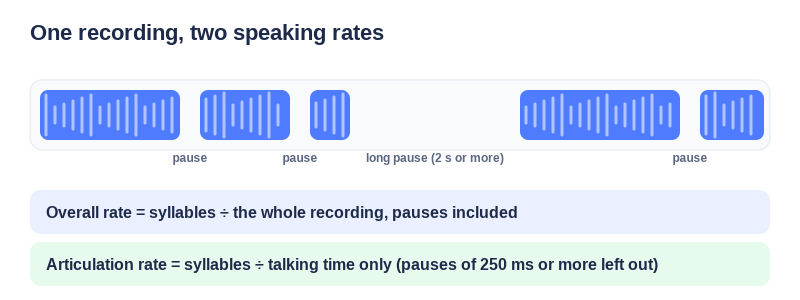
Rate can be measured in more than one way. In one research definition, overall speaking rate includes disfluencies and pauses shorter than 1–2 seconds, while articulation rate leaves pauses out, so it conveys more closely the pace at which speech is actually produced.20,2
How SLPs work on rate
Because slower isn’t automatically clearer, the decision about whether, and how much, to change rate belongs with a speech-language pathologist (SLP).
One research team notes that, because Parkinson’s often brings increased rate or acceleration during utterances, speech rate reduction is a common therapeutic technique to improve intelligibility. Parkinson’s UK describes speech pacing therapy, which encourages you to slow down your speech and may help you speak more clearly.15,6
ASHA lists pacing strategies for a reduced speaking rate in dysarthria, such as hand tapping, a pacing board, a metronome and delayed auditory feedback, alongside indirect strategies such as increased loudness or overarticulation. It also describes phrase grouping: matching breaths to natural pauses, so each breath carries only the syllables that can be said comfortably. A review of hypokinetic dysarthria adds that rate control can improve listener perceptions, especially combined with a loud voice.3,12
The evidence is still developing. ASHA’s summary of a 2007 systematic review calls the evidence for rate control in adult dysarthria preliminary, while the strongest evidence supports treatments targeting vocal loudness for adults with Parkinson’s and hypokinetic dysarthria. LSVT LOUD is an intensive programme that targets high effort to improve loudness, and a 2012 review by Fox and colleagues reports that its outcomes have been poor in individuals with significant rate disorders, such as palilalia.4,3,11
ASHA notes that certain techniques may not be the best fit for every person or every situation: the choice depends on the cause and type of dysarthria and which parts of speech are affected. Researchers describe the aim of identifying a rate that “will allow an optimal level of intelligibility without degrading naturalness unnecessarily”.3,18
Pacing boards, tapping and rhythm cues
Parkinson’s UK describes physical or digital aids called pacing boards, used so you can count out your words more slowly. In records from a UK pragmatic randomised controlled trial of speech and language therapy, low-tech aids to support pacing, such as an alphabet chart, a pacing board or body parts, were documented in four participants’ notes.6,10
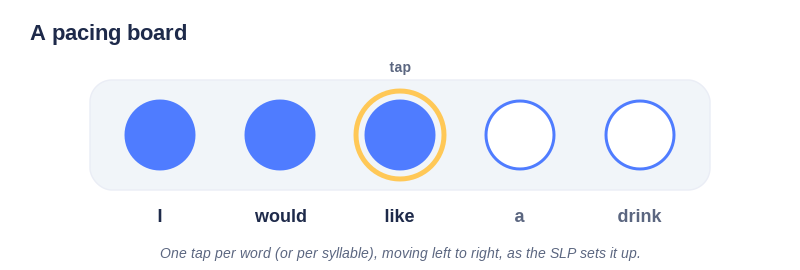
Other rate-reduction strategies described in the literature include finger tapping and a metronome, and less impaired speakers are frequently asked to pace themselves without external aids. A 2026 review reports that pacing boards, rhythmic auditory entrainment and delayed auditory feedback have been shown to regulate speech tempo and improve intelligibility in people with Parkinson’s who show rapid speech patterns. Group results in studies are more mixed: when 10 people with Parkinson’s had weekly sessions for 6 weeks of both traditional rate methods and altered auditory feedback, the group showed no significant change in rate or intelligibility with either, though some individuals improved with each technique.14,17
With altered auditory feedback, the speaker wears a device through which they hear their speech in an altered way, which disrupts the feedback loop and causes the speaker to slow down. In a reading study of 16 speakers with Parkinson’s and 11 control speakers under delayed and frequency-shifted feedback, all groups showed a prominent reduction of speech rate, and intelligibility and naturalness fell for all or some of the groups, though some speakers benefited despite the negative group results. Lowit and colleagues estimate that around 25 to 30% of people with Parkinson’s will show intelligibility benefits from altered auditory feedback, and that a person should show an immediate beneficial response to be considered for it.14,15
Use these methods only as your SLP advises: they decide whether a pacing aid or altered feedback suits you, and they teach you how to use it. SpeechStep does not offer delayed auditory feedback.
Practising pace with an SLP’s plan
Parkinson’s UK advises that it’s always best to see a speech and language therapist and use any specific strategies they’ve given you to manage your speech problems.6
Home practice fits inside that plan: your SLP decides whether rate is worth working on, which method to use and any target, and SpeechStep can help you see your pace and keep track of it. The free speaking rate test takes about 2 minutes: you read a short passage aloud, then talk freely for 30 seconds on a prompt. It shows each part’s rate in syllables per second side by side, and “View details” adds overall rate (pauses included), articulation rate (pauses of 250 ms or more left out, as the diagram above shows), pauses and long pauses of 2 seconds or more. The recording is analysed on your device, the free-speech number is approximate, and results are indicative, not a diagnosis; the test doesn’t identify any condition and doesn’t measure loudness or voice quality.
Free Speaking Rate Test
Read a short passage aloud, then talk freely for 30 seconds. Analysed on your device; indicative, not a diagnosis.
SpeechStep Pacing needs a free account: the first two pacing sessions are free, then it is part of Premium. Its exercises are steady reading, where a passage is highlighted at a steady guide pace, phrase pacing with marked pauses, and pause practice, and a re-test uses a matched passage with the same method so any change is comparable. The aim is controlled speech, not slower speech. Compare with your own earlier results and share them with your SLP, who sets any target.
- Record at a similar time of day each time so results are easier to compare.
- Compare like with like: reading with reading, free talk with free talk.
- Note anything that might have affected the day, such as feeling tired, and mention it to your SLP.
- Use the pace and strategies your SLP has advised rather than choosing your own target.
When to see an SLP
When to see an SLP
See an SLP if people often ask you to repeat yourself, if your speech speeds up or comes in rushes, or if talking feels harder work than it used to. You don’t need to wait for big changes: Parkinson’s UK recommends seeing one as soon as you can after diagnosis, because you may not notice small changes yourself. If speech changes suddenly, call your local emergency number straight away, because it can be a stroke. The find support page explains how to look for a qualified SLP through your country’s professional register.
In the UK, NICE guidance says to consider referring people in the early stages of Parkinson’s to a speech and language therapist with experience of Parkinson’s for assessment, education and advice, and to offer speech and language therapy to people having problems with communication. The Parkinson’s Foundation calls working with an SLP the gold-standard treatment for speech issues. In the US, ASHA’s ProFind lets you look for certified SLPs.5,7,1
What SpeechStep can and can’t do
SpeechStep shows your speaking pace and offers structured pacing practice to use alongside your SLP’s advice. It doesn’t identify, assess or treat Parkinson’s or dysarthria, doesn’t measure loudness or voice quality, doesn’t offer delayed auditory feedback or deliver LSVT LOUD, SPEAK OUT! or any other named programme, and never sets your target rate. Background noise can add or hide syllables, so results are best compared with your own earlier ones. If you opt in to human review, an authorised SpeechStep reviewer may listen to eligible recordings.
Frequently asked questions
Why does Parkinson’s make you talk fast?+
One research paper notes that hypokinetic dysarthria, the speech disorder associated with Parkinson’s, often results in increased speech rate or acceleration during utterances. Speeding up during utterances is thought to share similar mechanisms with festination in walking. An SLP can look at what is happening in your own speech.
What is festinating speech?+
Oral festination is a term researchers use for pace acceleration: a tendency for speech to speed up during utterances. It is thought to share similar mechanisms with festination in walking, and in one study its extent was linked with disease duration. Only a professional can say what is happening in a particular person’s speech.
Will speaking slower make my Parkinson’s speech clearer?+
Sometimes, but not always. Studies have found that cues to slow down did not help every speaker, with some individuals improving and others not, and in one study speaking loud or clear improved intelligibility while speaking slowly did not. Your SLP decides whether rate is worth working on for you.
Do pacing boards help with Parkinson’s speech?+
A 2026 review reports that pacing boards and other rate control methods have been shown to regulate speech tempo and improve intelligibility in people with Parkinson’s who show rapid speech patterns. Group results in some studies are mixed, with some individuals improving and others not. An SLP decides whether a pacing board suits you and how to use it.
Does LSVT LOUD help with fast speech?+
LSVT LOUD is an intensive programme that targets high effort to improve loudness, and the strongest evidence in Parkinson’s is for treatments targeting vocal loudness. A 2012 review by Fox and colleagues reports that LSVT LOUD outcomes have been poor in individuals with significant rate disorders, such as palilalia. An SLP can advise which approach fits your speech.
Can the speaking rate test tell if my Parkinson’s speech has changed?+
It can show your pace compared with your own earlier results, but it can’t tell you anything about Parkinson’s. The test is indicative, analysed on your device and not a diagnosis; it doesn’t identify any condition or measure loudness. Share your results with your SLP, who can interpret them.
Practise your own speech, one sound at a time
Free with an account: your first practice day is a full session of 14 words, then 5 words a day, with AI feedback on the sounds it supports. SpeechStep is practice, not therapy, and it doesn’t diagnose.
Need a licensed professional? Where to find a speech-language pathologist
References
20 sources from authoritative bodies. Last reviewed November 2026.
- 1.ASHAFind Certified Audiologists and Speech-Language Pathologists (SLPs) — Directory of certified professionals.
- 2.The Journal of the Acoustical Society of AmericaBetween-speaker and within-speaker variation in speech tempo of American English — Peer-reviewed study (PMC full text), 2010.
- 3.ASHADysarthria in Adults (Practice Portal) — Practice Portal page.
- 4.ASHAEvidence for Effectiveness of Treatment of Loudness, Rate, or Prosody in Dysarthria: A Systematic Review — Evidence Map summary of a systematic review, 2007.
- 5.National Institute for Health and Care Excellence (NICE)Parkinson's disease in adults (NG71): Recommendations 1.7 — Guideline, 2017.
- 6.Parkinson's UKSpeech and communication problems (last updated 13 December 2024) — Patient information page, 2024.
- 7.Parkinson's Foundation (US)Speech & Swallowing Issues — Patient information page.
- 8.National Institute of Neurological Disorders and Stroke (NIH)Parkinson's Disease (last reviewed 23 July 2026) — Patient information page, 2026.
- 9.Movement Disorders (Wiley; open access)Speech treatment in Parkinson's disease: Randomized controlled trial (RCT) (Ramig, Halpern, Spielman, Fox, Freeman) — Journal article (randomized controlled trial), 2018.
- 10.International Journal of Language & Communication Disorders (Wiley; open access)The PD COMM Process Evaluation: Describing Interventions and Implementation in a UK Pragmatic Randomised Controlled Trial of Speech and Language Therapy for People With Parkinson's-Related Dysarthria (Nicoll et al.) — Journal article (trial process evaluation), 2025.
- 11.Parkinson's Disease (Hindawi/Wiley; open access)LSVT LOUD and LSVT BIG: Behavioral Treatment Programs for Speech and Body Movement in Parkinson Disease (Fox, Ebersbach, Ramig, Sapir) — Journal article (review), 2012.
- 12.The Medical Bulletin of Sisli Etfal Hospital (open access)Hypokinetic Dysarthria in Parkinson's Disease: A Narrative Review (Sapmaz Atalar, Oguz, Genc) — Journal article (narrative review), 2023.
- 13.Journal of Speech, Language, and Hearing Research (author manuscript via PMC)Impact of Clear, Loud, and Slow Speech on Scaled Intelligibility and Speech Severity in Parkinson's Disease and Multiple Sclerosis (Tjaden, Sussman, Wilding) — Journal article, 2014.
- 14.International Journal of Speech-Language Pathology (accepted manuscript, University of Strathclyde repository)The effectiveness of traditional methods and altered auditory feedback in improving speech rate and intelligibility in speakers with Parkinson's disease (Lowit, Dobinson, Timmins, Howell, Kröger) — Journal article (accepted manuscript), 2010.
- 15.Journal of Medical Speech-Language Pathology (author manuscript via PMC)The effects of delayed and frequency shifted feedback on speakers with Parkinson's Disease (Brendel, Lowit, Howell) — Journal article, 2004.
- 16.Frontiers in Bioengineering and Biotechnology (open access)Automatic Evaluation of Speech Rhythm Instability and Acceleration in Dysarthrias Associated with Basal Ganglia Dysfunction (Rusz, Hlavnička, Čmejla, Růžička) — Journal article, 2015.
- 17.Movement Disorders Clinical Practice (Wiley; open access)Voice and Speech in Atypical Parkinsonian Disorders (Rodriguez-Porcel et al.) — Journal article (consensus review, CurePSP Center of Care network), 2026.
- 18.Journal of Speech, Language, and Hearing Research (article PDF on the authors' lab site, Western University)Variation in Speech Intelligibility Ratings as a Function of Speech Rate Modification in Parkinson's Disease (Knowles, Adams, Jog) — Journal article, 2021.
- 19.Journal of Speech, Language, and Hearing Research (abstract via PMC)Predicting Intelligibility Gains in Individuals With Dysarthria From Baseline Speech Features (Fletcher, McAuliffe, Lansford, Sinex, Liss) — Journal article (abstract), 2017.
- 20.Journal of Communication Disorders (Elsevier); NIH author manuscript PMC4081543Differences of articulation rate and utterance length in fluent and disfluent utterances of preschool children who stutter (Chon, Sawyer & Ambrose) — Journal article, 2012.
Keep reading
Speech Changes in Parkinson’s
How Parkinson’s can affect voice and speech, and when to get help.
Read →Soft Voice in Parkinson’s
Why your voice may get quieter without you noticing.
Read →Pacing Boards in Speech Therapy
What a pacing board is and how SLPs use one.
Read →Speech Rate Control
How clinicians work on speaking rate, and what the evidence says.
Read →