Sudden Stuttering in Adults: When to Get Help Now
If stuttering starts suddenly in an adult, especially with slurred speech, face drooping or arm weakness, treat it as a possible stroke and call your local emergency number. Once urgent causes are checked, a doctor and a speech-language pathologist work out the cause and next steps.
If it started suddenly: get medical help first
If speech changes suddenly
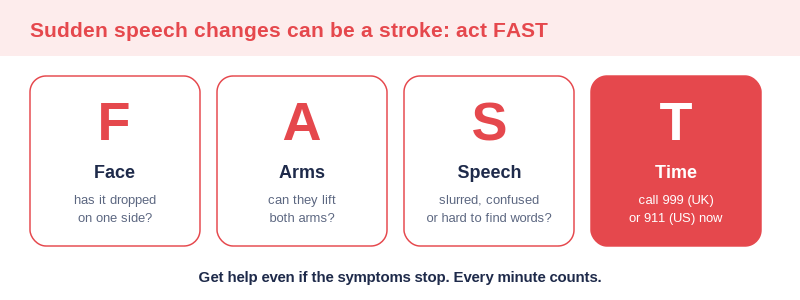
If your speech, or someone else’s, changes suddenly (slurred, garbled, hard to get out, or a new stutter), especially with a face drooping on one side or an arm that can’t be lifted, it can be a stroke. Call your local emergency number straight away: 999 in the UK, 911 in the US. Do this even if the symptoms stop, and don’t drive yourself to hospital.
The NHS says the main symptoms of a stroke can happen suddenly, and speech problems are one of them: you may slur your words, sound confused, or find it difficult to speak or think of words. Its reminder is FAST: face, arms, speech and time to call 999. MedlinePlus, from the US National Library of Medicine, says to call 911 right away if you think someone is having a stroke, because every minute counts.4,6
In one published case, a woman came to an emergency department with stuttering that had begun suddenly an hour earlier; it resolved within about 2 hours of her arrival, yet a scan showed a small stroke. The NHS says stroke symptoms can sometimes stop after a short time, and that even if this happens you should get medical help straight away.13,4
The Stuttering Foundation puts it plainly: in the vast majority of cases, disfluent speech that appears suddenly in an adult should be considered abnormal. STAMMA advises speaking to your GP as soon as possible if you’ve started stammering and don’t know why.8,10
Acquired stuttering explained
Most stuttering starts in early childhood, but it can start in adults too. Stuttering that first appears later in life is called acquired stuttering; a 2021 review describes it as usually linked to neurological events, side effects of certain medicines, or psychological trauma.10,9,12
The NHS uses the UK word stammering, which it notes is also sometimes referred to as stuttering. It describes acquired or late-onset stammering as relatively rare, happening in older children and adults after a head injury, stroke or progressive neurological condition, and says it can also be caused by certain drugs or medicines, or by psychological or emotional trauma.3
| Kind | Linked to | What the sources say |
|---|---|---|
| Neurogenic | A stroke, head injury, brain tumour, Parkinson’s or another degenerative disease, some forms of dementia, or multiple sclerosis | Speak to your GP as soon as possible |
| Medication-related | A prescribed medicine | Consult your doctor immediately, and seek medical advice before changing or stopping the medicine |
| Psychogenic or functional (rare) | A severely traumatic event, mental health difficulties, or prolonged emotional stress | Telling it apart from neurogenic stuttering is a challenge for clinicians |
| Cause not known | Nothing obvious | Speak to your GP as soon as possible; they can check for the conditions above |
Kinds of acquired stuttering, what the sources link them to, and what they say about each. If the change came on suddenly, emergency help comes first.10,11,12
Neurogenic stuttering
Neurogenic stuttering is a kind of acquired stuttering linked to brain damage. The Stuttering Foundation says it typically appears after injury or disease to the central nervous system, and NIDCD explains that the brain then has difficulty coordinating the different regions involved in speaking.12,8,2
Stroke is the most common cause. A 2024 study in the journal Brain notes that stroke accounts for half of the reported cases in the research literature, and that in one study of stuttering after stroke, 5% of patients met the criteria for neurogenic stuttering. A 2021 review adds that it often begins shortly after the stroke.14,12
It can happen at any age, but the Stuttering Foundation says it appears more often in adulthood, with the highest incidence in older people. Generally, people with it spoke without stuttering before the injury or illness, and many may appear unaware of, or at least unconcerned about, the changes in their speech.8,14
It can be associated with other communication disorders, including aphasia, dysarthria and apraxia of speech. It also behaves differently from stuttering that began in childhood: conditions that significantly lessen developmental stuttering, such as choral reading, singing, repeated reading of the same passage or delayed auditory feedback, often don’t ease neurogenic stuttering.12,8
Psychogenic stuttering
Psychogenic stuttering is rare. NIDCD notes that all stuttering was once believed to be psychogenic, caused by emotional trauma, but that today we know psychogenic stuttering is rare. When it does happen, the Stuttering Foundation says it may be linked to emotional stress or trauma the person has recently experienced.2,8
Sources use several names for it. STAMMA calls stammering that starts after a severely traumatic event, mental health difficulties or prolonged emotional stress “functional stammering” or “functional neurological stammering”, and a 2024 case report describes psychological stuttering as resulting from psychiatric conditions such as affective disorders, somatization and conversion disorder.10,13
The RCSLT says stammering is not caused by anxiety, though stressful environments can put an increased demand on speech. The Stuttering Foundation says people who stutter are no more likely to have psychological or emotional problems than people who don’t.11,7
Telling psychogenic and neurogenic stuttering apart is a challenge for clinicians, and the authors of the 2024 case report stress the importance of considering even minor strokes when stuttering appears.12,13
A stressful time in your life is not a reason to skip medical checks.
How it is assessed
Assessment starts with a doctor. STAMMA advises speaking to your GP as soon as possible if you’ve started stammering and don’t know why, because they can check for conditions such as stroke, head injury or a degenerative disease. If you take a prescribed medicine and your speech changes, it says to consult your doctor immediately.10
The Stuttering Foundation advises consulting a speech-language pathologist (SLP) who specialises in stuttering to make the diagnosis, and says the SLP will want input from the physicians involved in your care. A 2021 review describes treatment as usually requiring a joint effort between speech therapists and doctors, most often neurologists.8,12
In the UK, the RCSLT lists three routes for adults to a speech and language therapist: a referral by your GP, a self-referral to the local service, or contacting a private therapist directly. In the US, ASHA’s ProFind is one place to look for a certified SLP.11,1
When to see an SLP
If stuttering started suddenly, call your local emergency number straight away, because sudden speech changes can be a stroke. If it began after an injury, an illness or a new medicine, tell your doctor. Then see an SLP, ideally one with experience in stuttering, if the stuttering is still there, comes with other speech or language changes, or is affecting your work or social life. The find-support page explains how to look for one through your country’s register.
Speech therapy after medical checks
The Stuttering Foundation says there is no single treatment approach that is effective in alleviating the symptoms of neurogenic stuttering, and a 2021 review found no consensus on which method works best. Treatment is often carried out by an SLP working together with the person’s doctors.8,12
The same review notes that accurate and expeditious recognition of neurogenic stuttering can reduce or even prevent communication difficulties. STAMMA mentions an online group you can join called the Adults New To Stammering Support Group.12,10
Practising pace with your SLP’s advice
If your SLP suggests practising reading aloud or pausing between appointments, SpeechStep Pacing offers steady reading, phrase pacing and pause practice, with neutral feedback and re-tests on a matched passage so you can compare with your own earlier results. Any target is set by your SLP, not by SpeechStep. The aim is controlled speech, not slower speech.
Free Speaking Rate Test
Read a short passage aloud, then talk freely for 30 seconds. Analysed on your device; indicative, not a diagnosis.
The free speaking rate test takes about 2 minutes: you read a short passage aloud, then talk freely for 30 seconds, and see your rate for each part side by side. It is analysed on your device, the result is indicative, not a diagnosis, and it doesn’t identify stuttering or any other condition. Background noise can affect the count, so it’s most useful for comparing with your own earlier results.
What SpeechStep can and can’t do
SpeechStep is practice, not therapy. It doesn’t diagnose or assess stuttering or any other condition, and it can’t tell what is causing a change in your speech. It doesn’t offer delayed auditory feedback or deliver any named therapy programme. If you opt in, an authorised SpeechStep reviewer may listen to eligible recordings. For any sudden change in speech, call your local emergency number first; once a doctor has checked you, an SLP can help.
Frequently asked questions
Is sudden stuttering in adults a sign of a stroke?+
It can be. Stroke is the most common cause of neurogenic stuttering, and in one published case, sudden stuttering that resolved within about 2 hours turned out to be a small stroke. If stuttering starts suddenly, especially with slurred speech, face drooping or arm weakness, call your local emergency number (999 in the UK, 911 in the US), even if it stops.
Can stress or anxiety cause sudden stuttering?+
Rarely, stammering can start after a severely traumatic event, mental health difficulties or prolonged emotional stress; STAMMA calls this functional stammering. Telling it apart from neurogenic stuttering is a challenge for clinicians. According to the RCSLT, stammering is not caused by anxiety. Either way, if it started suddenly, get medical help straight away; a doctor needs to rule out other causes first.
Can medication cause stuttering?+
The NHS lists certain drugs and medicines among the causes of acquired stammering. STAMMA advises consulting your doctor immediately if your speech changes while you’re taking a prescribed medicine, and seeking medical advice before changing or stopping it.
What is neurogenic stuttering?+
Neurogenic stuttering is acquired stuttering linked to brain damage or disease, most often a stroke, but also a head injury, brain tumour or degenerative condition. It appears more often in adults, especially older adults, and it can be associated with other communication disorders such as aphasia or dysarthria.
Who should I see about stuttering that started as an adult?+
Start with a doctor, or emergency services if it came on suddenly, so medical causes can be checked. After that, an SLP who specialises in stuttering can make the diagnosis, working with your doctors. In the UK you can be referred by your GP or self-refer to your local speech and language therapy service.
Practise your own speech, one sound at a time
Free with an account: your first practice day is a full session of 14 words, then 5 words a day, with AI feedback on the sounds it supports. SpeechStep is practice, not therapy, and it doesn’t diagnose.
Need a licensed professional? Where to find a speech-language pathologist
References
14 sources from authoritative bodies. Last reviewed November 2026.
- 1.ASHAFind Certified Audiologists and Speech-Language Pathologists (SLPs) — Directory of certified professionals.
- 2.NIDCDStuttering — Health information page, 2017.
- 3.NHS (nhs.uk)Stammering (overview) — Health A to Z page, 2023.
- 4.NHS (nhs.uk)Symptoms of a stroke — Health A to Z page, 2024.
- 5.NHS (nhs.uk)Dysarthria (difficulty speaking) — Health A to Z page, 2023.
- 6.MedlinePlus, U.S. National Library of MedicineStroke — Health topic page, 2025.
- 7.Stuttering Foundation of AmericaFAQ — FAQ page.
- 8.Stuttering Foundation of AmericaNeurogenic Stuttering — Brochure page.
- 9.STAMMA (British Stammering Association)What Is Stammering? — Information page.
- 10.STAMMA (British Stammering Association)Help If You've Just Started Stammering — Information page.
- 11.Royal College of Speech and Language Therapists (RCSLT)Stammering overview — Public clinical information page, 2025.
- 12.Medical Archives (Academy of Medical Sciences of Bosnia and Herzegovina)Junuzovic-Zunic L., Sinanovic O. & Majic B. Neurogenic Stuttering: Etiology, Symptomatology, and Treatment — Review article (open access, CC BY-NC), 2021.
- 13.CureusSalter et al. Transient Stuttering as a Sole Presentation in a Patient With a Subcentimeter Left Frontal Cortical Ischemic Infarct — Case report (open access, CC BY), 2024.
- 14.BrainTheys C., Jaakkola E. et al. Localization of stuttering based on causal brain lesions — Journal article (open access, CC BY-NC), 2024.
Keep reading
Stuttering in Adults
How stuttering that began in childhood affects adult life, and where to find support.
Read →Speech After a Stroke
Communication changes after a stroke and how speech therapy fits into recovery.
Read →Slurred Speech
What slurred speech can mean and when it needs emergency help.
Read →Types of Stuttering
Developmental, neurogenic and psychogenic stuttering compared.
Read →