Cluttering in Adults: Signs, Challenges and Support
Cluttering is a fluency disorder in which speech sounds rapid, irregular, unclear or disorganised to listeners, and many adults who clutter don’t notice it. It’s often diagnosed late. An SLP with fluency expertise can assess it and work on pausing, awareness and clarity.
What cluttering is in adults
Cluttering is a communication disorder that affects how clearly and concisely you get a message across to other people. Like stuttering, it is a fluency disorder, but the two are not the same: cluttering involves speech that sounds rapid, unclear and/or disorganised.8,3
Cluttering starts in childhood but is not usually diagnosed until a child is at least 8. ASHA notes that people typically aren’t diagnosed or treated until 8 or into adolescence or adulthood, often only when someone else draws attention to their communication, and that some adults who clutter were first diagnosed with stuttering.7,5
Cluttering on its own is quite rare. The Royal College of Speech and Language Therapists (RCSLT) says it typically appears alongside one or more of stuttering, dyslexia, dyspraxia, ADHD, developmental language disorder or autism, although people diagnosed with ADHD don’t necessarily clutter. Research on cluttering is still limited, so some aspects are not yet understood.7,9
Signs SLPs describe
ASHA, drawing on St. Louis and Schulte, lists the characteristic signs of cluttering as a speech rate perceived to be “abnormally rapid” and/or irregular, an excessive number of nonstuttering-like disfluencies, frequent irregular patterns of pausing and/or frequent over-coarticulated speech.1
| Sign | How sources describe it |
|---|---|
| Rate | Heard as rapid and/or irregular, sometimes in bursts; the measured rate is not always faster than average |
| Disfluencies | Many fillers such as “um” and “uh”, repeated or revised phrases, without the struggle or tension seen in stuttering |
| Pausing | Pauses that are irregular or in unusual places |
| Clarity | Word endings left off, syllables collapsed, words that sound as if they run into each other |
| Message | Maze-like sentences, frequent topic shifts, difficulty sticking to the topic |
Signs of cluttering as professional sources describe them. Not everyone has all of them, and only a speech-language pathologist (SLP) with experience in cluttering can say whether they add up to cluttering.1,4,8,7,5
Speed on its own doesn’t define cluttering. ASHA notes that the measured rate is not always greater than average even though listeners hear it as rapid, and van Zaalen and Reichel write that the main concern is not the number of syllables per second but whether a speaker can adjust their rate. They also caution that not everyone with a fast rate should be diagnosed with cluttering.1,11,10
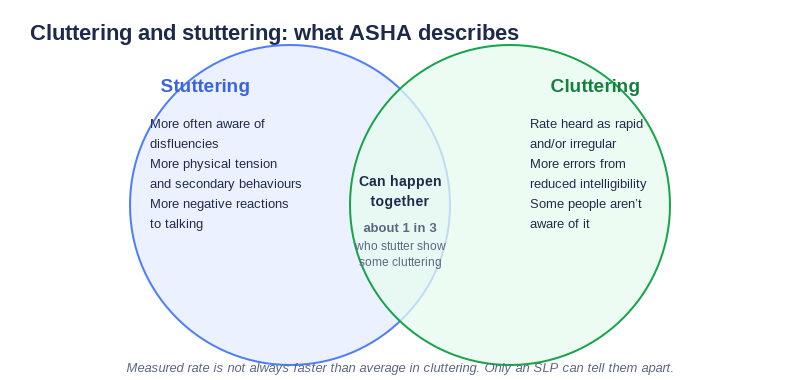
As the diagram shows, stuttering and cluttering can happen together. ASHA describes people who stutter as more likely to be aware of their disfluencies and to show more physical tension, while people who clutter may show more errors linked to reduced intelligibility. Experts estimate that about one third of people who stutter show some components of cluttering, though ASHA notes there are more clinical anecdotes than data behind that estimate.5,1
Awareness: why listeners often notice first
Unlike stuttering, many people who clutter are unaware of their communication difficulties, which is one reason many aren’t diagnosed until adulthood. The RCSLT says people who clutter typically don’t notice they’re speaking quickly but may realise a listener hasn’t understood, which can leave them frustrated, anxious or upset. ASHA adds that many are aware others find them hard to understand.8,7,5
Some people who clutter report being told “Slow down!” or “Don’t mumble”. Adults have described growing up with comments about “improving their communication” that tended to be vague, so they could never put a finger on what was causing them.8
Cluttering also varies with the situation. It is more likely to surface in informal, unstructured, emotional or linguistically complex talk, and speech is often at its best when the person is actively monitoring it, such as when being recorded. So a single short sample may not reflect how someone usually speaks.9,8,7
If you want a neutral record of your own pace, SpeechStep’s free speaking rate test has you read a short passage aloud and then talk freely for 30 seconds, and shows the two rates side by side. It is analysed on your device and the results are indicative, not a diagnosis: it doesn’t identify cluttering, stuttering or any other condition. Its most useful comparison is with your own earlier results.
Free Speaking Rate Test
Read a short passage aloud, then talk freely for 30 seconds. Analysed on your device; indicative, not a diagnosis.
Work, study and conversation
Cluttering can make busy spoken settings harder. Van Zaalen and Reichel describe people who clutter needing help to express their thoughts clearly and coherently in team meetings, and often getting answers that miss the point because the listener misunderstood. They also note that avoidance, such as not looking for better employment, can contribute to underachievement.11
The effects aren’t only practical. ASHA notes that people who clutter can experience communication avoidance, anxiety and negative attitudes towards talking, and its consumer site adds that avoiding speaking situations can lead to isolation and a lower quality of life. Questionnaire-based surveys suggest people who clutter tend to have higher levels of depressive and psychosomatic symptoms.5,6,13
Colleagues, friends and family can help. STAMMA suggests letting a person who clutters know when you can’t understand them, so they can use strategies such as pausing between phrases and sentences or over-articulating certain words.4
Assessment and treatment for adults
The International Cluttering Association says a definitive diagnosis can only be made by an SLP with experience in cluttering, and that an SLP with expertise in fluency disorders is often the ideal professional. ASHA notes that evaluation is more accurate when it includes self-report and speech samples from different situations, such as recordings made outside the clinic.8,1
Comparing your view of your speech with the clinician’s shows the SLP how aware you are of it. An SLP may also check how your speech changes when you add pauses or slow down; a lower overall rate typically helps reduce cluttering symptoms, though ASHA cautions that this kind of change doesn’t on its own settle whether it’s cluttering or stuttering.9,1
ASHA describes strategies that change how often and where pauses happen to improve fluency and message clarity. The RCSLT lists practising putting pauses in speech, working on awareness of your speech and of listener reactions, and recognising “when speech is too fast”. ASHA also notes that fluency shaping approaches such as easy onset or continuous phonation may not be effective for cluttering.1,7
Change takes effort. The Stuttering Foundation notes that for some people adding pauses is enough to make speech clearer, while for others unclear speech remains between the pauses, and the RCSLT says these strategies can be effortful and may be used only some of the time. Van Zaalen and Reichel list problem identification among the aims of cluttering therapy, and note that developing the internal feedback loop of self-observation, self-judgement and self-correction is often very slow.3,7,12
When to see an SLP
Consider talking to an SLP if people often ask you to repeat yourself, say they can’t follow you or tell you to slow down, or if you’ve started avoiding speaking situations at work or socially. Only an SLP can say whether this is cluttering, stuttering, both or something else, and set any goals for your practice.
Support, finding an SLP and practice
STAMMA notes that speech and language therapists (the UK term for SLPs) who specialise in stammering can also support people who clutter. In the US, ASHA’s ProFind lets you search for certified SLPs; our find-support page explains how to find an SLP through your country’s register.4,2
Practice can sit alongside therapy, with your SLP’s advice. SpeechStep Pacing, for teens and adults on the web, offers steady reading, phrase pacing with marked pauses and pause practice, with neutral feedback and re-tests on matched passages so you can compare with your own earlier results. Any goal for your pace or pausing is one your SLP sets, not SpeechStep. The aim is controlled speech, not slower speech.
What SpeechStep can and can’t do
SpeechStep’s tools and pacing practice help you hear and practise your pace and pauses. They don’t identify, assess or treat cluttering or any other condition; the speaking rate test is indicative and analysed on your device; and SpeechStep doesn’t measure loudness or voice quality. If you opt in to human review, an authorised SpeechStep reviewer may listen to eligible recordings and give practice feedback, not clinical guidance.
Frequently asked questions
What is cluttering in adults?+
Cluttering is a fluency disorder in which speech sounds rapid, unclear and/or disorganised to listeners. Signs ASHA lists include a rate perceived as “abnormally rapid” and/or irregular, an excessive number of nonstuttering-like disfluencies and irregular pausing, and words can sound as if they run into each other. Only an SLP with experience in cluttering can diagnose it.
Why wasn’t my cluttering diagnosed as a child?+
Cluttering starts in childhood but is not usually diagnosed before age 8, and people typically aren’t diagnosed until 8 or into adolescence or adulthood, often when someone else points out their communication. Many people who clutter are unaware of their difficulties, which is one reason diagnosis comes late. Some adults were first diagnosed with stuttering.
Is cluttering just talking fast?+
No. ASHA notes that in cluttering the measured rate is not always faster than average, even though listeners hear it as rapid, and van Zaalen and Reichel caution that a fast rate alone shouldn’t lead to a cluttering diagnosis. Cluttering also involves features such as irregular pausing and words running into each other.
How is cluttering treated in adults?+
The RCSLT says therapy can include practising putting pauses in speech, working on awareness of your speech and of listener reactions, and recognising “when speech is too fast”. ASHA describes changing how often and where pauses happen to improve message clarity, and notes that fluency shaping approaches such as easy onset may not be effective for cluttering.
Can cluttering affect work?+
It can. Van Zaalen and Reichel describe people who clutter needing help to express their thoughts clearly in team meetings and getting answers that miss the point because they were misunderstood, and avoidance can contribute to underachievement. ASHA also notes reactions such as communication avoidance and anxiety.
Can a speaking rate test tell me if I clutter?+
No. SpeechStep’s speaking rate test is indicative, analysed on your device and not a diagnosis, and it doesn’t identify cluttering or any other condition. Rate alone can’t answer the question, because the measured rate in cluttering is not always faster than average. An SLP with fluency expertise makes that assessment.
Practise your own speech, one sound at a time
Free with an account: your first practice day is a full session of 14 words, then 5 words a day, with AI feedback on the sounds it supports. SpeechStep is practice, not therapy, and it doesn’t diagnose.
Need a licensed professional? Where to find a speech-language pathologist
References
13 sources from authoritative bodies. Last reviewed November 2026.
- 1.ASHAStuttering, Cluttering, and Fluency — Practice Portal page.
- 2.ASHAFind Certified Audiologists and Speech-Language Pathologists (SLPs) — Directory of certified professionals.
- 3.Stuttering FoundationCluttering — Brochure (written by fluency researchers).
- 4.STAMMA (British Stammering Association)Cluttering — Information page.
- 5.ASHAStuttering, Cluttering, and Fluency (definitions, prevalence, cluttering vs stuttering, adults) — Practice Portal page.
- 6.ASHAStuttering and Cluttering — Consumer page.
- 7.Royal College of Speech and Language Therapists (RCSLT)Cluttering overview — Public clinical information page.
- 8.International Cluttering Association (compiled by K. Scaler Scott, F. Myers, P. Kissagizlis)What is Cluttering? — Information page.
- 9.International Cluttering Association, Clinical Issues Committee (van Zaalen, Myers, Ward, Bennett)Cluttering Assessment — Clinical guideline page.
- 10.Routledge (TalkBank copy)van Zaalen, Y. & Reichel, I. An Introduction to Cluttering (Section 5.2.1 Cluttering and tachylalia; Sections 2.2.7, 4.5.1) — Book, 2024.
- 11.Routledge (TalkBank copy)van Zaalen, Y. & Reichel, I. An Introduction to Cluttering (theory and assessment chapters) — Book, 2024.
- 12.Routledge (TalkBank copy)van Zaalen, Y. & Reichel, I. An Introduction to Cluttering (therapy chapters) — Book, 2024.
- 13.Frontiers in PsychologyTomisato S. et al. Social anxiety and life impact in adults who clutter and stutter: a comparative study with pure stuttering — Journal article (open access, CC BY), 2026.