Cluttering Symptoms: What Speech-Language Pathologists Look For
SLPs describe cluttering as speech heard as rapid and/or irregular, with pauses in unusual places, syllables that run together or drop off, and many “um”-type disfluencies. Measured rate isn’t always above average, so only an SLP can say if it’s cluttering.
Cluttering in one paragraph
Cluttering is a fluency disorder, like stuttering, but the two are not the same. The Stuttering Foundation describes cluttering as speech that sounds rapid, unclear and/or disorganised, and the International Cluttering Association (ICA) calls it a communication disorder that affects how clearly and concisely a person gets a message across.3,7
ASHA, citing St. Louis and Schulte (2011), lists the characteristic signs as a speech rate perceived to be “abnormally rapid” and/or irregular, an excessive number of nonstuttering-like disfluencies, frequent irregular patterns of pausing, and/or frequent over-coarticulated speech. The Royal College of Speech and Language Therapists (RCSLT) notes that cluttering starts in childhood but is not usually diagnosed until children are at least 8 years old, and that research about it is limited.1,6
People who clutter often report that listeners find them hard to understand, and put it down to their rate, the clarity of their speech or how their message is organised. Many are unaware of their communication difficulties, which the ICA gives as one reason many aren’t diagnosed until adulthood.7
Rate that sounds rapid or irregular
ASHA notes that the speaker’s measured rate is not always greater than average, but the listener perceives it as rapid. ASHA says this perceived rapid rate, and the breakdown in clarity that comes with it, is thought to be because people who clutter speak “at a rate that is too fast for their systems to handle”.1
The ICA’s assessment guidance says the same: the rate is perceived to be “abnormally rapid”, irregular or both, although measured syllable rates “may not exceed normal limits”. STAMMA, the UK stammering charity, describes talking in rapid bursts that make a person hard to understand.8,4
Van Zaalen and Reichel put the emphasis on control: the primary concern is not the number of syllables per second but whether a speaker can adjust their rate. The RCSLT notes that people who clutter may not be able to adjust their rate, and that syllables or words may run into each other. Not every speaker with a fast rate should be diagnosed with cluttering; van Zaalen and Reichel describe people with tachylalia as having shorter pauses that still fall in linguistically appropriate places.10,6,9
Pauses in unexpected places, and collapsed syllables
Pauses in unexpected places
ASHA lists frequent irregular patterns of pausing, and unusual prosody often due to atypical pauses. The RCSLT says people who clutter may pause in unusual places, and the Stuttering Foundation notes it is common for people who clutter to pause less often than speakers who don’t clutter. In van Zaalen and Reichel’s description, a fast rate in cluttering often coincides with short pauses in linguistically wrong places.1,5,6,3,9
Collapsed or unclear syllables
ASHA calls this over-coarticulated speech. Its examples include omitting word endings (“Turn the televisoff”) and deleting or collapsing syllables (“I wanwatevision”). The ICA’s list includes leaving off the ends of words and words that sound as if they are “running into each other”, and ASHA adds that some people who clutter have decreased loudness at the ends of sentences or phrases.1,7
Disfluencies and language
Everyone has times when speech isn’t smooth, such as saying “uh” or “you know”, or repeating words. People who clutter may have disfluencies that everyone experiences, not just the kinds people who stutter tend to have. The ICA notes that, unlike in stuttering, these disfluencies don’t come with struggle behaviours or muscular tension, and its assessment guidance contrasts the part-word repetitions, prolongations and blocks typical of stuttering with the “excessive but normal disfluencies” of cluttering.2,7,8
Cluttering can also show in how a message is put together. ASHA mentions maze behaviours and frequent topic shifting, and the RCSLT mentions lots of filler words and some difficulty sticking to the topic or making clear when the topic changes. The ICA lists word-finding problems, poor sentence structure and a lack of coherence in narratives among the language difficulties, and notes that people who clutter may not know all of what they want to say but continue talking anyway.5,6,8
Awareness varies. The RCSLT says people who clutter typically don’t notice they’re speaking quickly, but may realise listeners can’t follow, which can leave them frustrated, anxious or upset. ASHA adds that many are aware others have difficulty understanding them.6,5
Why a symptom list isn’t a diagnosis
ASHA points out that all speakers are disfluent at times. The RCSLT describes cluttering as highly variable, and the ICA says cluttering behaviours are more likely to surface as talk becomes more extemporaneous and informal, less structured, more emotional and linguistically more complex, and that a person may try to “normalize” their speech when being recorded.5,6,8
So having some of these features doesn’t on its own mean a person clutters, and one sample of speech may not show the whole picture. That is why the features are something an SLP weighs up, not a checklist to score yourself against.
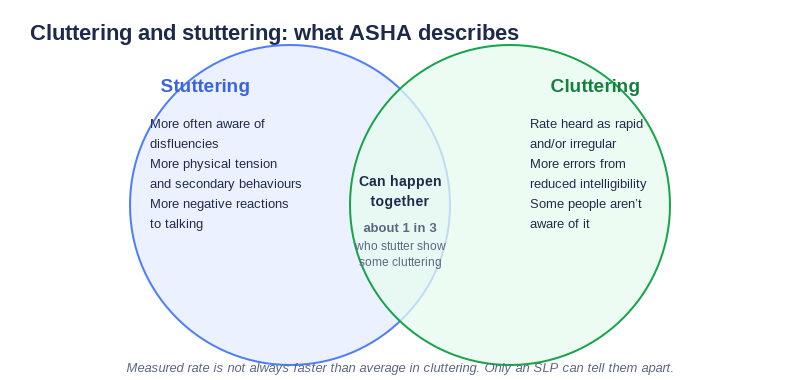
Cluttering overlaps with other conditions, too. Experts have estimated that approximately one third of children and adults who stutter also show some components of cluttering, though ASHA notes there are more clinical anecdotes than data behind this. The RCSLT says cluttering typically presents alongside one or more of stammering, dyslexia, dyspraxia, ADHD, developmental language disorder or autism, while the ICA notes that people diagnosed with ADHD don’t necessarily clutter.1,6,8
A 2024 study of Japanese speakers notes there is no established method to clearly tell cluttering from stuttering, and that the common definition of cluttering is highly subjective, with little interprofessional agreement.11
How an SLP assesses cluttering
The ICA says a definitive diagnosis of cluttering can only be made by a speech-language pathologist (SLP) with experience and expertise in it, and that an SLP with expertise in fluency disorders is often the ideal professional. In the UK, STAMMA notes that speech and language therapists who specialise in stammering can also support people who clutter.7,4
ASHA says evaluation is more accurate when it includes self-report and samples of speech across various situations and tasks, such as recordings made outside the clinic. The ICA adds that comparing the person’s view of their speech with the clinician’s can show how aware the person is.1,8
One part ASHA describes is stimulability testing: the person is asked to increase pausing or lower their rate some other way, and a reduction of overall rate typically helps reduce cluttering symptoms. ASHA cautions that a dramatic improvement in fluency with slower speech may be an indicator of cluttering rather than stuttering, but isn’t definitive, because similar changes may also occur with stuttering.1
When to see an SLP
Consider seeing an SLP if people often ask you to repeat yourself, say they can’t follow you, or if the way you speak is holding you back at work, in study or socially. Bring recordings of everyday speech if you can, since cluttering can vary between situations. Our find-support page explains how to find an SLP through your country’s register. If your speech changes suddenly (slurred, garbled or new stuttering), especially with face drooping or arm weakness, call your local emergency number straight away, because it can be a stroke.
Practising with your SLP’s advice
The RCSLT describes therapy that can include practising putting pauses into speech to slow it down overall, make it easier to understand and give more time to organise what is being said, alongside working on awareness of speech and of listener reactions. The Stuttering Foundation notes that for some people slowing rate by adding pauses is enough to increase speech clarity, while for others unclear speech still exists between the pauses, and ASHA notes that fluency-shaping approaches such as easy onset or continuous phonation may not be effective for cluttering.6,3,1
If your SLP suggests pacing practice, SpeechStep Pacing gives you a place to do it between sessions: steady reading with a passage highlighted at a steady guide pace, phrase pacing with marked pauses, and pause practice, with neutral feedback kept by task. Any pace or pause target comes from your SLP, not from SpeechStep. The aim is controlled speech, not slower speech.
Free Speaking Rate Test
Read a short passage aloud, then talk freely for 30 seconds. Analysed on your device; indicative, not a diagnosis.
The free speaking rate test is a way to compare with your own earlier results. You read a short passage aloud and then talk freely for 30 seconds; it’s analysed on your device, the result is indicative, not a diagnosis, and it doesn’t identify cluttering, stuttering or any other condition. Background noise can add or hide syllables, so record somewhere quiet.
What SpeechStep can and can’t do
SpeechStep can show your speaking rate for reading and for free talk side by side, and give you structured pacing practice to use within an SLP’s plan. It can’t tell you whether you clutter, assess or treat cluttering, or set a target for you. If you opt in to human review, an authorised SpeechStep reviewer may listen to eligible recordings; that is practice feedback, not clinical guidance.
Frequently asked questions
What are the symptoms of cluttering?+
ASHA describes the characteristic signs as a rate perceived to be “abnormally rapid” and/or irregular, an excessive number of nonstuttering-like disfluencies, frequent irregular pausing, and over-coarticulated speech, such as dropped word endings and collapsed syllables. The RCSLT adds lots of filler words and some difficulty sticking to the topic. Only an SLP experienced in cluttering can say whether these add up to cluttering.
Is cluttering just talking fast?+
No. ASHA notes that in cluttering the measured rate is not always greater than average, even though listeners perceive it as rapid. Van Zaalen and Reichel say not every speaker with a fast rate should be diagnosed with cluttering, and that the primary concern is whether a speaker can adjust their rate.
What’s the difference between cluttering and stuttering?+
ASHA says people who stutter are more likely to be self-aware about their disfluencies and may show more physical tension, while people who clutter may show more errors related to reduced intelligibility due to rapid rate. The ICA notes that the disfluencies of cluttering don’t come with struggle behaviours or muscular tension. ASHA also notes the two can co-occur.
Can I test myself for cluttering?+
No self-test can tell you. The ICA says a definitive diagnosis can only be made by an SLP with experience in cluttering, and ASHA says evaluation is more accurate with self-report and speech samples from various situations. SpeechStep’s speaking rate test is indicative, analysed on your device and not a diagnosis: it shows your rate but doesn’t identify cluttering or any other condition.
Do people who clutter know they clutter?+
Often not. The RCSLT says people who clutter typically don’t notice they are speaking quickly, though they may realise listeners can’t understand them. The ICA says many are unaware of their communication difficulties, while ASHA notes many are aware others find them hard to understand.
Can adults be diagnosed with cluttering?+
Yes. ASHA says people are typically not diagnosed or don’t start treatment until 8 years of age or into adolescence or adulthood, often only when someone else draws attention to their communication. Some adults who clutter may have first been diagnosed with stuttering.
Practise your own speech, one sound at a time
Free with an account: your first practice day is a full session of 14 words, then 5 words a day, with AI feedback on the sounds it supports. SpeechStep is practice, not therapy, and it doesn’t diagnose.
Need a licensed professional? Where to find a speech-language pathologist
References
11 sources from authoritative bodies. Last reviewed November 2026.
- 1.ASHAStuttering, Cluttering, and Fluency — Practice Portal page.
- 2.CHSA (ASHA consumer site)Stuttering and Cluttering — Consumer page (asha.org/public now redirects here).
- 3.Stuttering FoundationCluttering — Brochure (written by fluency researchers).
- 4.STAMMA (British Stammering Association)Cluttering — Information page.
- 5.ASHAStuttering, Cluttering, and Fluency (definitions, prevalence, cluttering vs stuttering, adults) — Practice Portal page.
- 6.Royal College of Speech and Language Therapists (RCSLT)Cluttering overview — Public clinical information page.
- 7.International Cluttering Association (compiled by K. Scaler Scott, F. Myers, P. Kissagizlis)What is Cluttering? — Information page.
- 8.International Cluttering Association, Clinical Issues Committee (van Zaalen, Myers, Ward, Bennett)Cluttering Assessment — Clinical guideline page.
- 9.Routledge (TalkBank copy)van Zaalen, Y. & Reichel, I. An Introduction to Cluttering (Section 5.2.1 Cluttering and tachylalia; Sections 2.2.7, 4.5.1) — Book, 2024.
- 10.Routledge (TalkBank copy)van Zaalen, Y. & Reichel, I. An Introduction to Cluttering (theory and assessment chapters) — Book, 2024.
- 11.Frontiers in PsychologyTomisato S. et al. Speech characteristics that differentiate stuttering and cluttering in Japanese speakers — Journal article (open access, CC BY), 2024.
Keep reading
What Is Cluttering?
A plain overview of cluttering and how it affects communication.
Read →Cluttering vs Stuttering
How the two fluency disorders differ and how they overlap.
Read →Cluttering in Adults
Late diagnosis, work and everyday life, and finding an SLP.
Read →Cluttering Exercises
What practice within an SLP’s plan can involve.
Read →