Delayed Auditory Feedback (DAF): What It Is and Who It Helps
Delayed auditory feedback (DAF) plays your voice back a fraction of a second late. Some people who stutter speak more fluently with it, but effects vary and last only while it’s used. Group studies in stuttering and Parkinson’s found no overall benefit, though some people gained. Ask an SLP.
How DAF works
Delayed auditory feedback, or DAF, plays your voice back to you a fraction of a second after you speak. STAMMA (the British Stammering Association) says it can feel like speaking along with someone else, and some people find they stutter less while it’s running.4,7
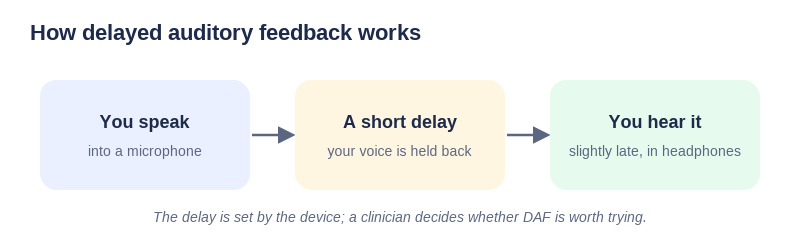
As the diagram shows, DAF works by delaying what you hear of your own voice, and it is used in several assistive devices, many of which combine DAF with frequency-altered feedback (FAF). The NHS describes these devices as often fitted inside or around the ear, similar to a hearing aid.10,4
A 2026 review notes that some studies suggest shorter delays (under 100 milliseconds) may reduce disfluencies, while longer delays (over 200 milliseconds) have been linked with mixed or sometimes adverse effects.10
SpeechStep doesn’t offer DAF, and this page doesn’t recommend any device or app. It explains what DAF is and what research has found, so you can talk it through with a speech-language pathologist (SLP).
DAF and stuttering
Stuttering, sometimes called stammering, is a speech disorder with repeated sounds, syllables or words, stretched sounds, and interruptions known as blocks.3
A widely accepted explanation is that DAF slows speech or makes it more prolonged, particularly at longer delays. Yet fluency has also been seen during fast speech with short delays of 50–75 ms, which suggests slower speech isn’t always necessary.10
In his lectures on stuttering treatment, Onslow describes the slow, drawling speech pattern DAF creates as the basis for today’s most popular treatments for adolescents and adults who stutter. He also notes that DAF devices are now rarely used clinically: clinicians teach people who stutter how to use a new speech pattern instead.9
STAMMA says effects vary, may not last, and last only while you’re using the app or device, and the NHS adds that these techniques don’t work for everyone and can be hard to use in some speaking situations.7,4
The Stuttering Foundation notes that neurogenic stuttering is often not eased by conditions that help developmental stuttering, including DAF, and a cluttering textbook by van Zaalen and Reichel states there is no empirical support for DAF in cluttering.6,8
DAF and Parkinson’s or dysarthria
Speech changes in Parkinson’s often include a faster rate or speeding up during a sentence, and speech rate reduction is a common therapy technique to improve intelligibility. ASHA lists DAF among strategies for reducing speaking rate in adult dysarthria, alongside pacing with hand tapping, a pacing board or a metronome.15,12
In a study by Brendel, Lowit and Howell, 16 people with Parkinson’s and 11 control speakers read aloud with and without altered feedback. All groups slowed down markedly, but intelligibility and naturalness fell for all or some groups, although some speakers still benefited.15
Lowit and colleagues compared altered feedback with traditional rate-reduction methods in 10 people with Parkinson’s, in weekly sessions over six weeks. As a group, neither approach changed speech rate or intelligibility, though individual speakers improved with each, and the slower speech produced by altered feedback didn’t automatically mean clearer speech.14,11
A 2026 review reports that, for people with Parkinson’s who speak rapidly, rate control strategies such as pacing boards, rhythmic cueing and DAF have been shown to regulate speech tempo and improve intelligibility.16
The NHS says that a drooping face, being unable to lift both arms, or difficulty speaking (speech that may be slurred or garbled) can be signs of a stroke, which is a medical emergency, and that you should call 999. Stroke symptoms usually come on suddenly.5
What the evidence says
A 2026 systematic review and meta-analysis of DAF in stuttering by Iimura and colleagues combined five studies with 61 participants. It found no significant overall benefit of DAF compared with unaltered feedback, and concluded that DAF alone doesn’t consistently reduce disfluencies, though some people and conditions may gain more.10
| Source | Who | What it found |
|---|---|---|
| Iimura et al. 2026 (meta-analysis) | 5 studies, 61 participants, stuttering | No significant overall benefit of DAF alone |
| Brendel, Lowit & Howell 2004 | 16 speakers with Parkinson’s and 11 controls, reading aloud | Speech slowed; intelligibility and naturalness fell for all or some groups; some individuals benefited |
| Lowit et al. 2010 | 10 people with Parkinson’s, weekly for 6 weeks | No group change in rate or intelligibility; some individuals improved |
| Rodriguez-Porcel et al. 2026 (review) | People with Parkinson’s who speak rapidly | Rate control, including DAF, reported to regulate tempo and improve intelligibility |
Selected findings on DAF and altered feedback, as each source reports them.10,15,14,16
NIDCD says electronic devices may help some people’s fluency in a relatively short time, but more research is needed on how long the effects last and whether people can use them easily in real-world situations.3
For Parkinson’s, Lowit’s team estimated that around 25 to 30% of people with Parkinson’s will show intelligibility benefits from altered feedback, and that people should show an immediate benefit to be considered for it. For stuttering, Iimura and colleagues advise clinicians to interpret DAF’s effects cautiously when it’s used alone.14,10
Trying DAF with an SLP
NIDCD advises working with an SLP to find the best treatment options for stuttering, and ASHA notes that choosing strategies for dysarthria depends on its cause, its type and the parts of speech affected.1,12
Parkinson’s UK says it’s always best to see a speech and language therapist and use the specific strategies they give you. In the UK, STAMMA notes that NHS funding for fluency devices is not generally available.13,7
When to see an SLP
Whether DAF fits is a decision for an SLP who knows your speech. Talk to an SLP if stuttering, a rushed pace or unclear speech is affecting your work, relationships or confidence, or before you spend money on a DAF device. If speech changes suddenly, call your local emergency number first. Our find-support page explains how to look up an SLP through your country’s register.
Understanding your own pace, without DAF
If you want to understand your speaking pace, the free speaking rate test is a separate, simpler step. You read a short passage aloud, then talk freely for 30 seconds, and see each part’s rate in syllables per second side by side. It’s analysed on your device, it’s indicative, not a diagnosis, and it doesn’t identify stuttering, cluttering or any other condition.
Free Speaking Rate Test
Read a short passage aloud, then talk freely for 30 seconds. Analysed on your device; indicative, not a diagnosis.
Results are best compared with your own earlier results. SpeechStep Pacing adds steady reading, phrase pacing and pause practice; if you have stuttering, Parkinson’s or dysarthria, use it with your SLP’s advice. The aim is controlled speech, not slower speech.
In research on clear speech, talkers trained to speak clearly at conversational rates increased intelligibility for normal-hearing listeners with simulated hearing losses, in noise, though to a slightly smaller degree than clear speech at slow rates.2
What SpeechStep can and can’t do
SpeechStep offers guided pacing practice and a free, indicative speaking rate test analysed on your device. An authorised SpeechStep reviewer may listen to eligible recordings if you opt in to human review. SpeechStep doesn’t offer DAF or any altered-feedback device, doesn’t measure loudness or voice quality, doesn’t deliver any named therapy programme, and doesn’t diagnose or treat stuttering, Parkinson’s or dysarthria.
Frequently asked questions
What is delayed auditory feedback?+
Delayed auditory feedback (DAF) plays your own voice back to you a fraction of a second after you speak. STAMMA says it can feel like speaking along with someone else, and some people find they stutter less while using it.
Does DAF work for stuttering?+
It helps some people, but not reliably. A 2026 meta-analysis found no significant overall benefit of DAF alone, though some people and conditions may gain more. Any useful effect lasts only while the device or app is in use.
Is there a delayed auditory feedback app I can use?+
Apps and devices that change how you hear your voice exist, and some people speak more fluently with them in certain situations. STAMMA says effects vary and may not last. SpeechStep doesn’t offer DAF and doesn’t recommend any app or device, so talk to an SLP before trying one.
Is DAF used in speech therapy?+
ASHA lists DAF among strategies for reducing speaking rate in adult dysarthria. For stuttering, Onslow notes that DAF devices are now rarely used clinically, and clinicians teach a new speech pattern instead.
Can DAF help with Parkinson’s speech?+
Results vary by person. In two studies, group results showed no gain in intelligibility, though some individuals benefited. One research team estimated that around 25 to 30% of people with Parkinson’s will show intelligibility benefits, and that people should show an immediate benefit to be considered for it.
Does SpeechStep offer DAF?+
No. SpeechStep offers a free speaking rate test (indicative, analysed on your device, not a diagnosis) and pacing practice for controlled, clear speech. It doesn’t offer DAF or any altered-feedback device, and it doesn’t diagnose or treat any condition.
Practise your own speech, one sound at a time
Free with an account: your first practice day is a full session of 14 words, then 5 words a day, with AI feedback on the sounds it supports. SpeechStep is practice, not therapy, and it doesn’t diagnose.
Need a licensed professional? Where to find a speech-language pathologist
References
16 sources from authoritative bodies. Last reviewed November 2026.
- 1.NIDCDWhat Is Stuttering? Diagnosis & Treatment — Health information page.
- 2.Language and Linguistics CompassSpeaking and Hearing Clearly: Talker and Listener Factors in Speaking Style Changes — Peer-reviewed review (PMC full text), 2009.
- 3.NIDCDStuttering — Health information page, 2017.
- 4.NHS (nhs.uk)Treatment - Stammering — Health A to Z page, 2023.
- 5.NHS (nhs.uk)Dysarthria (difficulty speaking) — Health A to Z page, 2023.
- 6.Stuttering Foundation of AmericaNeurogenic Stuttering — Brochure page.
- 7.STAMMA (British Stammering Association)Stammering Apps & Devices — Information page.
- 8.Routledge (TalkBank copy)van Zaalen, Y. & Reichel, I. An Introduction to Cluttering (therapy chapters) — Book, 2024.
- 9.University of Technology Sydney / Australian Stuttering Research CentreOnslow M. Stuttering and its Clinical Management: Twelve Lectures — Clinical lecture book (August 2026 edition), 2026.
- 10.International Journal of Language & Communication DisordersIimura D., Yamamoto T. & Ishida O. Immediate Effects of Delayed Auditory Feedback on Stuttering: A Systematic Review and Meta-Analysis of Literature Published 2000-2024 — Systematic review and meta-analysis (open access, CC BY), 2026.
- 11.International Journal of Speech-Language Pathology (accepted manuscript, Strathprints)Lowit A. et al. The effectiveness of traditional methods and altered auditory feedback in improving speech rate and intelligibility in speakers with Parkinson's disease — Journal article (accepted manuscript), 2010.
- 12.ASHADysarthria in Adults (Practice Portal) — Practice Portal page.
- 13.Parkinson's UKSpeech and communication problems (last updated 13 December 2024) — Patient information page, 2024.
- 14.International Journal of Speech-Language Pathology (accepted manuscript, University of Strathclyde repository)The effectiveness of traditional methods and altered auditory feedback in improving speech rate and intelligibility in speakers with Parkinson's disease (Lowit, Dobinson, Timmins, Howell, Kröger) — Journal article (accepted manuscript), 2010.
- 15.Journal of Medical Speech-Language Pathology (author manuscript via PMC)The effects of delayed and frequency shifted feedback on speakers with Parkinson's Disease (Brendel, Lowit, Howell) — Journal article, 2004.
- 16.Movement Disorders Clinical Practice (Wiley; open access)Voice and Speech in Atypical Parkinsonian Disorders (Rodriguez-Porcel et al.) — Journal article (consensus review, CurePSP Center of Care network), 2026.
Keep reading
Pacing Boards in Speech Therapy
What a pacing board is and how SLPs use it.
Read →Speech Rate Control
How rate control is used in therapy, and what the evidence says.
Read →Does Slowing Down Help Stuttering?
What research says about rate and stuttering.
Read →Fast Speech in Parkinson’s
Why speech can speed up in Parkinson’s, and who can help.
Read →