Does Talking Slower Help Stuttering?
Slowed or prolonged speech is typically the main part of speech restructuring, a stuttering treatment. Being told to “slow down” is different: most people who stammer find such advice intrusive, and the slowing needed to reduce stuttering may not be functionally useful on its own.
The short answer
Yes and no. Reduced speech rate is part of many modern stuttering treatments, but Onslow notes in his lectures on stuttering that the amount of slowing needed to reduce stuttering in a clinically useful way may not, of itself, be functionally useful.19
For teens and adults, many current therapies focus on ways to minimise stuttering, such as speaking more slowly, regulating breathing, or building gradually from single-syllable responses to longer words and more complex sentences. Speech restructuring, one such approach, uses a novel speech pattern to reduce or eliminate stuttering while sounding as natural as possible.3,19
Most people in the UK, Ireland and India call it stammering; in North America and Australia most people call it stuttering. In one study of school-age children, those who don’t stutter had faster speech rates, based on both fluent and disfluent utterances, than those who do, while articulation rates, based only on fluent utterances, were not significantly different. In that study, disfluency frequency predicted speech rate better than age or utterance length.13,7
How rate is used in some treatments
Speech restructuring, also called fluency shaping or prolonged speech, teaches a person a new speech pattern, and slowed or prolonged speech is typically its primary component. Variants go by names such as prolonged speech, smooth speech, easy speech and precision fluency shaping.18,19
ASHA groups these under speech modification strategies, which aim to change the timing and tension of speech or the frequency and placement of pauses. Examples it lists include easy or gentle onset, light articulatory contact, continuous phonation and prolonged syllables.8
SpeechStep doesn’t teach these techniques. They’re learned with a trained clinician, not from a web page.
One publicly available example is the Camperdown Program, a speech restructuring treatment supported by clinical trials, including a Phase III trial. Its treatment guide says a professionally qualified clinician must train and supervise people using it, that adults need around 10–20 hours to complete Stages I–III, and that there is no evidence for its efficacy in children younger than 12.19,20
Stuttering modification works differently: it typically aims to reduce physical tension and struggle, and many clinicians integrate several approaches. A 2013 review found that speech restructuring has the most robust evidence base for adults and does reduce stuttering frequency, but that maintaining constant control in everyday speaking situations can be very difficult.8,18
Why “just slow down” doesn’t work
Onslow writes that virtually everyone who stutters reports being told at some time to “slow down”. He suggests the advice is presumably based on an assumption by casual observers that stuttering comes from trying to speak too quickly.19
In a study Onslow describes, a 30% reduction in speech rate reduced stuttering severity by 35% for the participants with the most severe stuttering, leaving them with considerable stuttering.19
STAMMA notes that suggesting someone “slow down”, “relax” or “stop and breathe” shows you are focused on how they speak rather than what they say, and that most people who stammer find such advice intrusive and embarrassing. It suggests not finishing their sentences either: listen and be patient. NHS guidance likewise says to avoid asking them to speak faster or more slowly.16,9
Nor is stuttering a sign of nerves. The Royal College of Speech and Language Therapists says stammering is not caused by anxiety, though stressful environments can put increased demand on speech, and the Stuttering Foundation says people who stutter are no more likely to have psychological or emotional problems than people who don’t.17,11
Rate, naturalness and comfort
Speech restructuring involves a trade-off between fewer stuttering moments and speech that sounds natural. In the Camperdown Program, clients learn to shape unnatural-sounding stutter-free speech into more natural-sounding speech, and they decide their own goals: some prioritise less stuttering, while for others sounding natural matters most, even if that involves some stuttering.19,20
STAMMA says you may start by speaking in a very prolonged, slow, exaggerated way, with the speed gradually increased as you become more confident using the strategies. The aim is to find the point where you can speak with minimal stammering but still sound natural.15
Blomgren describes “controlled normal rate” as the rate at which a person who stutters can speak with little or no stuttering, and notes that the final rate varies for each client.18
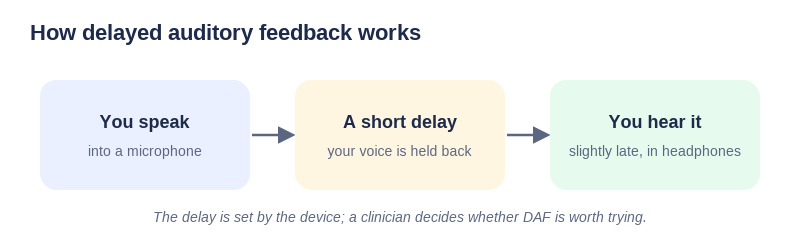
Delayed auditory feedback is shown in the diagram. Onslow writes that it generally creates a slow, drawling speech pattern that reduces or eliminates stuttering, but that it is rare for DAF devices to be used clinically now. A 2026 meta-analysis of five studies with 61 participants found no significant overall benefit of DAF compared with normal auditory feedback, and the same review notes fluency enhancement during fast speech with short delays of 50–75 ms, suggesting slower speech is not always necessary.19,21
What children who stutter need from adults
With children, adults change their own pace rather than asking the child to change theirs. The Stuttering Foundation says your own slow, relaxed speech will be far more effective than criticism or advice such as “slow down” or “try it again slowly”, and suggests speaking unhurriedly, pausing frequently, and waiting a few seconds after your child finishes before you speak.5
The NIDCD gives similar advice: speak in a slightly slowed and relaxed manner, which can help reduce time pressures the child may be experiencing, focus on the content of the message rather than how it is said, and don’t try to complete the child’s sentences. ASHA’s list of modifications that can ease communication and reduce negative internal reactions includes reducing their own communication rate, focusing more on what is said than how it is said, and using indirect prompts rather than direct questions.3,1
- Talk with your child at an unhurried pace yourself, with plenty of pauses.
- Wait a few seconds after your child finishes before you start to speak.
- Ask fewer questions, so your child can share their own ideas.
- Help everyone in the family take turns talking and listening.
- Let your child finish; don’t complete their sentences.
The NHS says stammering is not caused by anything parents have done, and that you should get advice if you have any concerns about your child’s speech or language development. The ASHA consumer site suggests contacting an SLP if, for example, a child has been stuttering for 6–12 months or more, starts to stutter late (after 3½ years old), or tenses up or struggles when talking.4,2
Practising pace safely
If you stutter, do any rate work with an SLP’s advice or within their plan, and let your SLP decide whether it belongs there at all.
The NIDCD says it is important to work with a speech-language pathologist to determine the best treatment options. The Camperdown guide says it is best to practise with someone you feel very comfortable with, such as a family member or good friend, and that talking on your own generally is not useful speech practice.3,20
In research on clear speech, talkers trained to speak clearly at conversational rates increased intelligibility for normal-hearing listeners with simulated hearing losses, in noise, though to a slightly smaller degree than clear speech at slow rates. In studies of English conversational speech intelligibility, overall speaking rate showed either no correlation with intelligibility or a correlation for some but not all talkers.6
Free Speaking Rate Test
Read a short passage aloud, then talk freely for 30 seconds. Analysed on your device; indicative, not a diagnosis.
The free speaking rate test has you read a short passage aloud, then talk freely for 30 seconds, and shows both rates in syllables per second side by side. It is analysed on your device, it is indicative, not a diagnosis, and it doesn’t identify stuttering or any other condition. SpeechStep Pacing then offers steady reading, phrase pacing and pause practice, and its exercise footer puts the idea simply: the aim is controlled speech, not slower speech. If your SLP thinks these fit your plan, any target comes from your SLP, and the most useful comparison is with your own earlier results.
When to see an SLP
When to see an SLP
An SLP can help you weigh up approaches, including whether rate work belongs in your plan at all. In the UK, if stammering has a significant impact on your social and work life, you can ask a GP to refer you to a speech and language therapist, or refer yourself to your local service. Elsewhere, look for a registered SLP through your country’s register; our find support page explains how.
The Stuttering Foundation says that in the vast majority of cases the sudden appearance of disfluent speech in an adult should be considered abnormal, and STAMMA advises speaking to a GP as soon as possible if you’ve started stammering and don’t know why. If speech suddenly becomes slurred or garbled, especially with a drooping face or arm weakness, the NHS says these can be signs of a stroke, a medical emergency: call your local emergency number straight away.12,14,10
What SpeechStep can and can’t do
SpeechStep can help you see your speaking pace and practise steady reading, phrasing and pauses, and an authorised SpeechStep reviewer may listen to eligible recordings if you opt in to human review. It doesn’t identify, assess or treat stuttering, it doesn’t offer delayed auditory feedback or any named therapy programme, and it doesn’t set rate targets. The speaking rate test is indicative, analysed on your device, and not a diagnosis.
Frequently asked questions
Does talking slower help stuttering?+
Slowed or prolonged speech is typically the primary component of speech restructuring, which has the most robust evidence base for adults. But Onslow notes that the slowing needed for clinically useful stuttering reduction may not be functionally useful of itself. In the Camperdown Program, for example, a qualified clinician trains and supervises clients as they shape unnatural-sounding stutter-free speech into more natural-sounding speech.
Should people who stutter slow down?+
Not because someone tells them to. Most people who stammer find advice to “slow down” or “relax” intrusive and embarrassing, and STAMMA suggests listening patiently and not finishing their sentences. The NIDCD says it’s important to work with a speech-language pathologist to determine the best treatment options.
What is prolonged speech?+
Prolonged speech is one name for speech restructuring, also called fluency shaping: a person learns a new speech pattern in which slowed or prolonged speech is typically the primary component. The Camperdown Program is one speech restructuring treatment; a qualified clinician trains and supervises it, and clients learn to shape unnatural-sounding stutter-free speech into more natural-sounding speech.
Is stuttering caused by talking too fast?+
Onslow describes the idea behind “slow down” advice as an assumption by casual observers that stuttering comes from speaking too quickly. In one study of school-age children, those who don’t stutter had faster speech rates than those who do, while articulation rates were not significantly different.
Does delayed auditory feedback help stuttering?+
DAF plays your voice back a fraction of a second after you speak and generally creates a slow, drawling speech pattern. A 2026 meta-analysis found no significant overall benefit of DAF compared with normal auditory feedback, and Onslow notes it is rare for DAF devices to be used clinically now. SpeechStep doesn’t offer DAF.
Can I check my speaking rate if I stutter?+
You can try the free speaking rate test, which shows your reading-aloud and free-talk rates side by side. It’s analysed on your device, indicative and not a diagnosis, and it doesn’t identify stuttering. If you work with an SLP, ask whether rate fits into your plan.
Practise your own speech, one sound at a time
Free with an account: your first practice day is a full session of 14 words, then 5 words a day, with AI feedback on the sounds it supports. SpeechStep is practice, not therapy, and it doesn’t diagnose.
Need a licensed professional? Where to find a speech-language pathologist
References
21 sources from authoritative bodies. Last reviewed November 2026.
- 1.ASHAStuttering, Cluttering, and Fluency — Practice Portal page.
- 2.CHSA (ASHA consumer site)Stuttering and Cluttering — Consumer page (asha.org/public now redirects here).
- 3.NIDCDWhat Is Stuttering? Diagnosis & Treatment — Health information page.
- 4.NHSStammering — Health A to Z page.
- 5.Stuttering Foundation7 Tips for Talking With Your Child — Parent brochure.
- 6.Language and Linguistics CompassSpeaking and Hearing Clearly: Talker and Listener Factors in Speaking Style Changes — Peer-reviewed review (PMC full text), 2009.
- 7.Journal of Communication Disorders (author-hosted full text, UT Austin)Logan K.J., Byrd C.T., Mazzocchi E.M. & Gillam R.B. Speaking rate characteristics of elementary-school-aged children who do and do not stutter — Journal article, 2011.
- 8.ASHAStuttering, Cluttering, and Fluency (treatment approaches for adults, support) — Practice Portal page.
- 9.NHS (nhs.uk)Treatment - Stammering — Health A to Z page, 2023.
- 10.NHS (nhs.uk)Dysarthria (difficulty speaking) — Health A to Z page, 2023.
- 11.Stuttering Foundation of AmericaFAQ — FAQ page.
- 12.Stuttering Foundation of AmericaNeurogenic Stuttering — Brochure page.
- 13.STAMMA (British Stammering Association)What Is Stammering? — Information page.
- 14.STAMMA (British Stammering Association)Help If You've Just Started Stammering — Information page.
- 15.STAMMA (British Stammering Association)Adult Stammering Options Explained — Information page.
- 16.STAMMA (British Stammering Association)How To Talk To Someone Who Stammers — Information page.
- 17.Royal College of Speech and Language Therapists (RCSLT)Stammering overview — Public clinical information page, 2025.
- 18.Psychology Research and Behavior ManagementBlomgren M. Behavioral treatments for children and adults who stutter: a review — Review article (open access), 2013.
- 19.University of Technology Sydney / Australian Stuttering Research CentreOnslow M. Stuttering and its Clinical Management: Twelve Lectures — Clinical lecture book (August 2026 edition), 2026.
- 20.Australian Stuttering Research CentreO'Brian S. et al. The Camperdown Program Stuttering Treatment Guide — Treatment guide, 2018.
- 21.International Journal of Language & Communication DisordersIimura D., Yamamoto T. & Ishida O. Immediate Effects of Delayed Auditory Feedback on Stuttering: A Systematic Review and Meta-Analysis of Literature Published 2000-2024 — Systematic review and meta-analysis (open access, CC BY), 2026.
Keep reading
Fluency Shaping vs Stuttering Modification
Two treatment approaches, what each aims for, and how they combine.
Read →Stuttering Techniques for Adults
What adult stuttering treatments involve and who delivers them.
Read →Delayed Auditory Feedback
How DAF works and what the evidence says.
Read →Controlled Speech, Not Slower Speech
Why clear pacing is about control rather than speed.
Read →