Fluency Shaping vs Stuttering Modification
Fluency shaping teaches a new way of speaking, using techniques such as gentle onsets and stretched syllables, to reduce moments of stuttering. Stuttering modification aims instead to reduce the tension and struggle in stuttering. Many clinicians integrate several approaches.
Two approaches, different aims
Speech-language pathologists (SLPs) working with adults who stutter draw on two broad families of techniques: speech modification, which includes fluency shaping, and stuttering modification. ASHA describes these as two different treatment approaches for improving fluency that can be used separately or at the same time.2
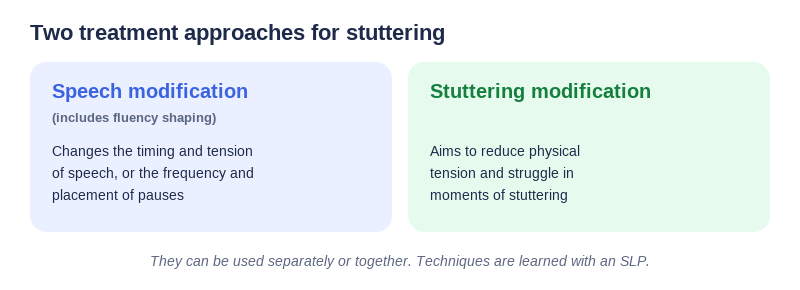
As the diagram shows, the aims differ. In STAMMA’s plain-language summary, fluency shaping aims to reduce moments of stuttering so you speak more fluently, while stuttering modification doesn’t aim for fluency as such but to reduce the tension involved in speaking, so there’s less of a struggle.5
Stuttering and stammering are the same thing: stammering is the word most people in the UK, Ireland and India use. STAMMA is also clear that there is no quick fix, and that none of these options can make stuttering stop.4,5
Fluency shaping
Fluency shaping is also called speech restructuring or prolonged speech. The person is taught to use a new speech pattern, and slowed or prolonged speech is typically its primary component.7
ASHA lists techniques aimed at changing the timing and tension of speech. They include easy or gentle onset (a gradual start to voicing), light articulatory contact (easy positions for sounds like P and T), continuous phonation (keeping the voice going through an utterance) and prolonged, stretched syllables.2
STAMMA says you may start by speaking in a very prolonged, slow, exaggerated way, with the speed gradually increased as you become more confident, aiming for a point where you stutter little but still sound natural. Onslow describes this as a trade-off between fewer moments of stuttering and speech that sounds natural.5,8
Blomgren’s 2013 review found that speech restructuring has the most robust evidence base for adults, and a relatively wide range of published studies indicate it reduces how often stuttering happens. The same review notes that most “pure” speech restructuring approaches don’t address negative feelings, unhelpful attitudes or anxiety, and that keeping control in everyday speaking situations can be very difficult.7
One structured example is the Camperdown Program, a speech restructuring treatment supported by clinical trials including a Phase III trial. Its guide says a qualified clinician must train and supervise people using it, and describes it as a way to control stuttering rather than make it disappear.8,9
Stuttering modification
ASHA says the goal of stuttering modification is typically to reduce physical tension and struggle. Techniques it names include preparatory set, where the speaker anticipates a moment of stuttering before it happens, and cancellation, where the speaker pauses for a few seconds after a stuttered word.2
STAMMA describes learning ways to release excess tension when stuttering, alongside desensitisation work so you feel better about stuttering itself.5
Blomgren gives the main goals as accepting stuttering, reducing the fear and anxiety associated with it, and stuttering with less effort. The review also names a long-standing gap: research on how effective stuttering management approaches are is lacking.7
Learned with a clinician
The techniques on this page are described so you know what to expect from therapy. Both families are learned with a trained clinician who adapts them to you, not from a written page.
Side by side
| Aspect | Fluency shaping (speech modification) | Stuttering modification |
|---|---|---|
| Main aim | Fewer moments of stuttering and more fluent speech | Less physical tension and struggle; doesn’t aim for fluency as such |
| Example techniques (ASHA) | Easy onset, light contact, continuous phonation, prolonged syllables | Preparatory set, cancellation |
| Feelings about speaking | Most “pure” versions don’t address negative feelings or anxiety | Goals include acceptance and less fear and anxiety |
| Research evidence | Most robust evidence base for adults | A long-standing problem is that effectiveness research is lacking |
| Trade-offs | Fewer stuttering moments versus natural-sounding speech; control can be very difficult to keep in everyday situations | Doesn’t aim to make speech more fluent |
Fluency shaping and stuttering modification compared, as ASHA, STAMMA, Blomgren and Onslow describe them.5,2,7,8
STAMMA notes that you may find a combination of different elements is useful for you.5
Combined approaches
ASHA notes that many clinicians integrate several approaches, and Blomgren describes more recent attempts to combine stuttering management and speech restructuring.2,7
The NHS says therapy with older children and adults will often take account of both speaking behaviours and the social, emotional and psychological aspects of stuttering. It describes therapies that don’t treat stuttering directly but can be helpful if you have negative feelings as a result of it.3
ASHA gives cognitive behavioural therapy as an example of cognitive restructuring, an approach that teaches people to identify thought patterns and challenge cognitive distortions to reduce negative emotions. It describes ARTS as an approach that aims to decrease the struggle that, for some people, can accompany stuttering.2
Working on feelings doesn’t mean nerves cause stuttering: the RCSLT states that stammering is not caused by anxiety, though stressful environments can put extra demands on speech. ASHA adds that treatment for adults is ideally individualised, dynamic and multidimensional.6,2
Choosing with an SLP
NIDCD advises working with a speech-language pathologist to work out the best treatment options. In the UK, adults can ask a GP for a referral, refer themselves to the local speech and language therapy service, or contact a private speech and language therapist.1,6
Goals are personal. The Camperdown guide says clients decide: some prioritise less stuttering over natural-sounding speech, while for others sounding natural matters most, even with some stuttering. STAMMA likewise says different people find different things helpful.9,5
- Which approach, or mix of approaches, do you suggest for me, and why?
- How will we balance fewer stuttering moments against sounding natural?
- How will we work on feelings about speaking, not just the speech itself?
- What should I practise between sessions, and with whom?
- How will we check what changes in everyday situations, not only in sessions?
When to see an SLP
See an SLP if stuttering affects your work, relationships or willingness to speak, or if you want to explore either approach. If stuttering has started suddenly in adulthood, get medical help first. The find support page explains how to find an SLP through your country’s register.
Practising between sessions
For the Camperdown Program, the guide says it’s best to practise with someone you feel very comfortable with, such as a family member or good friend, and that talking on your own generally isn’t useful speech practice.9
SpeechStep Pacing offers steady reading, phrase pacing and pause practice for teens and adults. If you stutter, use it only with your SLP’s advice and within their plan, and let your SLP set any target. The aim is controlled speech, not slower speech.
Free Speaking Rate Test
Read a short passage aloud, then talk freely for 30 seconds. Analysed on your device; indicative, not a diagnosis.
The free speaking rate test asks you to read a short passage aloud and then talk freely for 30 seconds, and shows syllables per second for each part side by side. It’s analysed on your device, it’s indicative, not a diagnosis, and it doesn’t identify stuttering or any other condition. Compare results with your own earlier ones, and share them with your SLP if they find them useful.
What SpeechStep can and can’t do
SpeechStep can help you see your speaking pace and practise steady reading, phrasing and pauses. It doesn’t diagnose, assess or treat stuttering, it doesn’t teach fluency shaping or stuttering modification techniques, and it doesn’t deliver or imitate any named therapy programme.
Frequently asked questions
What is the difference between fluency shaping and stuttering modification?+
Fluency shaping changes the timing and tension of speech to reduce moments of stuttering. Stuttering modification doesn’t aim for fluency as such; it aims to reduce the tension and struggle in moments of stuttering. ASHA notes they can be used separately or together.
What are fluency shaping techniques?+
ASHA lists easy or gentle onset, light articulatory contact, continuous phonation and prolonged syllables. In speech restructuring, also called fluency shaping or prolonged speech, a client is taught to use a new speech pattern.
What are stuttering modification techniques?+
ASHA names preparatory set, where the speaker anticipates a moment of stuttering, and cancellation, where the speaker pauses after a stuttered word. STAMMA describes learning to release excess tension and working on desensitisation so you feel better about stuttering.
Which works better, fluency shaping or stuttering modification?+
Blomgren’s review found speech restructuring has the strongest evidence for adults, while effectiveness research on stuttering management is lacking. But most “pure” speech restructuring approaches don’t address negative feelings or anxiety, and control can be very difficult to keep in everyday situations. Many clinicians integrate several approaches.
Is fluency shaping just speaking slowly?+
Slowed or prolonged speech is typically the primary part of the new pattern, but STAMMA says the speed is gradually increased towards speech that still sounds natural. Onslow notes that, of itself, the rate reduction needed for clinically useful stuttering reduction may not be functionally useful. The aim is controlled speech, not slower speech.
Can I learn fluency shaping on my own?+
For the Camperdown Program, one speech restructuring treatment, the guide says a professionally qualified clinician must train and supervise people using it, and that it isn’t meant for clients without a clinician’s support. NIDCD advises working with an SLP to determine the best treatment options.
Practise your own speech, one sound at a time
Free with an account: your first practice day is a full session of 14 words, then 5 words a day, with AI feedback on the sounds it supports. SpeechStep is practice, not therapy, and it doesn’t diagnose.
Need a licensed professional? Where to find a speech-language pathologist
References
9 sources from authoritative bodies. Last reviewed November 2026.
- 1.NIDCDWhat Is Stuttering? Diagnosis & Treatment — Health information page.
- 2.ASHAStuttering, Cluttering, and Fluency (treatment approaches for adults, support) — Practice Portal page.
- 3.NHS (nhs.uk)Treatment - Stammering — Health A to Z page, 2023.
- 4.STAMMA (British Stammering Association)What Is Stammering? — Information page.
- 5.STAMMA (British Stammering Association)Adult Stammering Options Explained — Information page.
- 6.Royal College of Speech and Language Therapists (RCSLT)Stammering overview — Public clinical information page, 2025.
- 7.Psychology Research and Behavior ManagementBlomgren M. Behavioral treatments for children and adults who stutter: a review — Review article (open access), 2013.
- 8.University of Technology Sydney / Australian Stuttering Research CentreOnslow M. Stuttering and its Clinical Management: Twelve Lectures — Clinical lecture book (August 2026 edition), 2026.
- 9.Australian Stuttering Research CentreO'Brian S. et al. The Camperdown Program Stuttering Treatment Guide — Treatment guide, 2018.
Keep reading
Stuttering techniques for adults
What adult stuttering therapy can include, and who delivers it.
Read →Does slowing down help stuttering?
What research says about speech rate and stuttering.
Read →Stuttering in adults
How stuttering affects adults, and where to find support.
Read →Speech fluency exercises
Practice ideas to discuss with your SLP.
Read →